Field Trip to Big Island Woods (Cooper’s Island) Coming Up

Hackberry, a frequent canopy tree at Big Island Woods. Photograph by Richard Brewer.

Saturday 24 April I’m leading a field trip to the Big Island Woods, also referred to as Cooper’s Island.  It’s a trip for the Kalamazoo Wild Ones chapter.

“Big Island Woods” refers to an “island” of forest in the middle of Prairie Ronde, southwest Michigan’s largest mesic (tall-grass) prairie. The village of Schoolcraft was founded just east of the Island.  Of the Island’s original 300 acres or more, about 20 acres now remain.  The site is probably the natural area in southwest Michigan most worthy of permanent protection, for its combination of ecological, botanical, and historic values.

Historically, Prairie Ronde and the Big Island are interesting because of their connection with the earliest settlers in Kalamazoo County (such as Bazel Harrison), with James Fenimore Cooper (whence “Cooper’s Island”), and with Clarence and Florence Hanes, authors of The Flora of Kalamazoo County.

Ecologically, the remnant of the Big Island that survives is of interest because of its unusual species composition, its similarity to prairie groves of Illinois, and several rare plant species.  The forest could perhaps be called wet mesic and has a diverse canopy, despite a windstorm about ten years ago that blew down many large trees.

Probably the most unusual plant species is the white trout lily, known from only one other site in Kalamazoo County.  Two other rare plants are the trees Ohio buckeye and blue ash.  There are, in addition, many other plants of mesic forest and southern swamp forest, including a relatively rich complement of spring ephemerals.

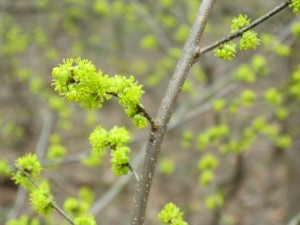
Red-berried elder in bud, early April, at Big Island Woods. Photograph by Richard Brewer.

Down trunks and woody debris from the wind storm about a decade ago make travel somewhat difficult in some parts of the woods.

Relatively little work has been done on the biota other than plants.  However, as a wooded island surrounded by agricultural fields and village streets, it could be an important stopover site for migratory  birds.  In less than two afternoon hours on 11 May 1996 three observers found 42 bird species including 14 species of warblers.

The trip will leave from the I-94 car-pool parking lot at Oakland Drive, Kalamazoo, at 9:15 AM Saturday.  Because parking at the field trip site is limited to about five cars, car-pooling is essential.  The field trip will conclude about noon.

Later on, after the trip, I’ll try to write something about what we saw and talked about at Cooper’s Island.

Posted in Birds, Conservation, Land Trusts (& other private land conservation), Michigan (including Kalamazoo), Plants and Plant Communities | Leave a comment

Kalamazoo County Spring 2010, Second Installment

I wrote the following last night.  Today, temperatures jumped into the 70s–77 as I write this at 6 PM.  The forecast is for highs in the 70s and 80s for the next three days.  So much for stretching out the spring.

Beech-maple forest in early spring, Pavilion Township. Photograph by Richard Brewer.

A stretch of chilly weather, especially some cool nights below freezing, has kept spring from racing ahead the way it sometimes does.  This is good; summer is a fine time, but there are lots of things to experience in spring and it’s more fun to have them spread out rather than all happen in a week.

When I wrote my last post, no frogs had been calling as yet, but soon after, the afternoon of 17 March, wood frogs were calling in the small kettles such as the one shown in the preceding post.

Finding another sound to match any animal’s voice is difficult.  But saying that wood frog calls sound like the feeding chuckle of ducks is not a bad comparison. The frog calls are a little louder, I think, and each one sounds quite fervent, unlike the kind of absent-minded noodling of a bunch of dabbling ducks. But the comparison is a pretty good way to give other people an idea of what wood frogs sound like.

I have heard no chorus frogs or spring peepers yet.  We usually think of these two as the earliest frogs here in eastern North America, but some years wood frogs have been earlier in my experience.  I’m not sure, though, that–for whatever reason–peepers and chorus frogs aren’t rarer than they used to be.

Another animal that I believe was decidedly less common the past few months than in preceding years is the white-footed mouse.  I don’t go out and census mice in the woods; I base this impression on how many mice I trap each winter in the house.  The house here in Oshtemo Township is in oak forest. Beginning when the nights start to get cold, the mice start to find ways to get inside.  I trap them with ordinary mouse traps baited with a little peanut butter with a couple of sunflower seeds stuck in the peanut butter or inserted elsewhere on the trigger of the trap.  Most winters I trap a couple of dozen white-footed mice.  This winter I caught a couple of mice early on and then no more through most of November, December, January, and February.  I also set traps in my house in the southeast part of Kalamazoo County, in beech-maple forest.  Most years I catch several mice through the winter, but this past winter only a couple.

I don’t know what may have happened to the mice this winter and I don’t know whether it’s temporary or a permanent decline.  Next fall and winter may give me a clue.

Floerkea proserpinacoides, False Mermaid Weed, Big Island Woods, March 30, 2010. Photograph by Richard Brewer.

But that’s getting ahead of ourselves.  It’s early spring.  The wood frogs are calling.  In the beech-maple forest, harbinger of spring, our earliest spring wild flower is finishing up (a blog called Kalamazoo Seasons has a nice photo of the flower). The very first spring beauty flowers have opened. Wild leek is up.

And the little annual Floerkea proserpinacoides with its pale-green narrow leaflets is spread profusely over the ground in the few woodlots where it occurs, but is not quite in bloom yet.  This odd mesic forest specialist deserves a better vernacular name than the obscure, bookish “false mermaid weed.”  Maybe we need a contest for a new, better-fitting name for it.

Anyway it’s spring and will be for a good month yet, maybe longer.  Let’s enjoy it.

Leaves of wild leek, March 2010, Pavilion Township. Photograph by Richard Brewer.

Posted in Michigan (including Kalamazoo), Plants and Plant Communities | Leave a comment

Signs of Spring

Open water in March in a buttonbush swamp, Oshtemo Township. Photo by Richard Brewer.

Spring began in southwest Michigan in the past few days.   One sign has been the Sandhill Cranes overhead, giving their loud rattle.  They could be on their way north or they could be local birds; several pairs now nest in Kalamazoo County.

Because snow cover was so continuous, and thick, some birds that are usually here by February were mostly delayed into early March.  The cranes are one species, Red-winged Blackbirds are another. I saw my first redwing a few days ago and they’re now pretty well scattered over the countryside.

In Pavilion Township Saturday, Song Sparrows were singing, Horned Larks were on territory in the open fields, and sailing overhead was my first Turkey Vulture of the new year. First in Michigan anyway; we saw Turkey and Black Vultures every day in Costa Rica. Most were probably resident there, but some could have been wintering birds from North America. This morning I saw my second Turkey Vulture sailing above West Main in Oshtemo Township.

I haven’t heard any frogs calling yet, and chilly as it is I don’t expect any tonight, but warmer weather is predicted for tomorrow.

As soon as bare patches began to appear around houses, the early spring bulbs were visible, some flowering.  I’ve already seen winter aconite, snow drops, and crocuses in bloom without hunting very hard.  Our native early spring wildflowers grow mostly in the mesic deciduous forests, and many of them are spring ephemerals–they come up, bloom, and then die back, so for most of the year they’re invisible above ground.  Right now the beech-maple forests probably have harbinger-of-spring in flower, and in the wooded low spots currently occupied by temporary vernal pools, skunk cabbage flowers will be out, though perhaps not producing pollen quite yet.

Acute-leaved hepatica, an early spring wild flower, but not a spring ephemeral. Photographed in an Oshtemo Township oak forest by Richard Brewer.

Our native early spring flowers take advantage of the brief window of full sun that opens between the arrival of warmer weather and the closing of the forest canopy by sugar maples.  It would make sense that the cultivated spring bulbs we buy and plant might be the early spring flowers from the deciduous forests of other parts of the Earth, but that isn’t the case.  Rather, most of the spring bulbs blooming in our front yards come from the steppes or the alpine and sub-alpine meadows of the Middle East and Asia.

The seasons follow one another in a continuous cycle.  A year has no natural beginning and no end.  Several groups of ancients gave the winter solstice, around December 21, special significance because it was the day they were reassured that the sun was actually coming back for another year. Our New Year’s Day, January 1 is arbitrary but since it comes not too long after the solstice, it’s not wholly unsatisfactory as a starting point in the cycle.

To me, though, the first definite signs of spring in nature, the sorts of things that have happened in the past week or so, feel like the engine of the year starting up.  In our temperate latitudes, this is the start of the year’s organic production; photosynthesis really gets underway, storing sunlight that, passed on along the food chain, runs nearly the totality of the living world. For a high percentage of the creatures here, spring is the time for beginning reproduction as well as production.  Eggs hatch and babies are born, and young of the year having new combinations  of genes not quite the same as either parent go out to become part of a later generation–or not.

Spring has arrived in southwest Michigan–I think–and a new year has started.  Happy New Year!

Posted in Birds, Michigan (including Kalamazoo), Plants and Plant Communities | 1 Comment

Costa Rica in the Dry Season, February 2010

Friday night sundown, Gulf of Nicoya, from hilltop at La Ensenada. Photo by Richard Brewer.

Katy and I just returned from two weeks in Costa Rica.  As part of an Elderhostel–though the program is now called Exploritas–we visited five sites ranging from mangrove forest along the Pacific Coast to the rather chaparral-like vegetation called paramo around 11,000 feet above sea level on Cerro de la Muerte.  Included were visits to several important conservation areas, including  La Selva (and Selva Verde) and a site in the Savegre River valley.

Spending eight or more hours a day in the field, our group identified, or had identified for it, about 280 species of birds.  On one night excursion we heard and saw the Common Pauraque (but no potoos).  We also saw 2- and 3-toed sloths, howler monkeys, collared peccaries and a few other mammals plus various herp species including crocodiles and caimans, 2 species of iguanas, several other lizards, a few frogs, and the cane toad, native here but with a bad reputation in places where it has been introduced, like St. Croix, US Virgin Islands.

Interest in resource conservation is high in Costa Rica.  For one thing, ecotourism, which is what we were participating in, is a major element in the nation’s economy.  The subjects of ecotourism’s costs and benefits and how sustainable it is are complex, but as an incentive for setting aside natural lands, the impact has been positive and powerful.

At Selva Verde. Photo by Richard Brewer.

I’ll write more about our observations and experiences.  For now, I’ll say just that they involved a lot of interesting and beautiful wildlife and plants, spectacular scenery, lots of good food, and good company.

Posted in Birds, Conservation, Land Trusts (& other private land conservation), Plants and Plant Communities | Leave a comment

Colony Farm Orchard: A Time for Knowledge, Wisdom, Conscience

Large maples, Colony Farm Orchard, fall 2009. Photo by Richard Brewer

The Kalamazoo Gazette for Sunday 14 February carried a Viewpoint I wrote which they titled WMU can keep orchard in natural state.  It had been altered slightly, improving the message in some ways.  Nevertheless, I prefer the version below. Posting it here may also be useful to those who missed the piece in the Sunday paper.  It was on the first section’s back page, which was otherwise totally occupied by a large advertisement for a heartburn medication.  But I was grateful to the Gazette for fitting it in anywhere and continue to regard newspaper conservation as a cause almost as important as land conservation.

Neighbors, WMU Alumni and Friends, and All Others Interested in Conservation: All that is required for the Colony Farm Orchard to be saved is for the WMU President and Board of Trustees to decide to set it aside as conservation land. Nothing prevents this. Please send President Dunn your recommendation. Do this now, even if you have contacted him before to provide current sentiment.

What should happen to the Colony Farm Orchard? House Bill 5207 said nothing about this question. The bill’s only effect was to remove the restriction that required public use for open space. Now that WMU can do whatever it likes with the land, the question becomes, What is the right use?

Feelings of local conservationists have been growing more antagonistic for seven months–feelings that they were kept in the dark by WMU, stone-walled rather than engaged in dialog, feelings that the attempt to remove the conservation covenant was in itself a betrayal of public trust, and feelings that the legislature and governor snubbed an outpouring of grass-roots sentiment that every civics class says is an essential element in our system of government.

People are also unhappy with WMU’s campaign based on a claim of job creation.  With able and willing citizens out of work, thoughtful critics see “job creation” as a cynical fiction, since the claim makes sense only if one realizes that jobs would be few, several years away, and bought at heavy expense to WMU and tax-payers. There is plenty of expansion room at the old BTR Park and then, if ever needed, at ready and waiting brownfields.

But all this is water over the dam.  Now that the WMU board and administration can do anything with the land, what should they do?

If the land could talk, it would likely say that its best use is pretty much what it’s been doing.  The Declaration of Conservation Restrictions for the Asylum Lake Preserve adopted by the WMU Board in 2004 states as its first goal promoting ecosystem integrity by maintaining the Preserve as green space and wildlife habitat and protecting natural features from further degradation.

If the Orchard were developed, WMU would be abandoning the last two aims. Development would diminish the Preserve; its status as wildlife habitat and its natural features would be degraded. Wildlife populations at Asylum Lake would fluctuate more, some would decline, and some declines would end in local extinction. It is easy to underestimate the Orchard’s role in the functioning of Asylum Lake Preserve. The Orchard and the Preserve are ecologically connected.

Ron Sims, the new U.S. Deputy Secretary of Housing and Urban Development, was known for preserving open space in his last job in Seattle as County Executive of King County.  He had come to realize that protected natural areas and open space are as important for the lives of the urban dwellers that were his natural constituency as for others. First-hand experience with natural land is valuable for everyone, but even when people are unable to visit the land, it enriches their lives by providing a great variety of services whose effects extend tens, hundreds, or thousands of miles. Included are things as simple as nurturing birds and butterflies any of us can enjoy in the sky and as complex as participating in the global carbon cycle.

Though the restrictive covenant on the Colony Farm Orchard is gone, the land is the same, still providing essential ecosystem services to the Preserve and to all of us, and still deserving permanent protection. The only difference is that now the protection will have to come from knowledge, wisdom, and conscience on the part of the WMU board and administration.

Email address: john.dunn@wmich.edu. US Postal address: President John Dunn, Western Michigan University, Kalamazoo, Michigan 4908-5202.

If you wish, you could send a cc or a note to colonyfarmorchard@gmail.com, to let others who wish to save the Orchard see your views.

Posted in Conservation, Land Trusts (& other private land conservation), Michigan (including Kalamazoo) | Leave a comment

Colony Farm Orchard Art by Lad Hanka and Others at KNC

KNCMapBeginning this weekend the Kalamazoo Nature Center will feature an art exhibition that includes images from the Colony Farm Orchard.  The show, entitled “Sacred Trees,” includes prints by Ladislav R. Hanka and paintings and photography by Sniedze Rungis and Zaiga Minka Thorson.   The opening is Sunday 7 February 1-3 P.M.

Lad Hanka, a Kalamazoo artist with strong natural history interests, has been one of the leading proponents of the view that the Colony Farm Orchard should be maintained as open space.  A 19 July 2009 email, sent by him to several  local conservationists began, “A significant portion of the Asylum Lake Preserve is in imminent danger of destruction. The threat is real as I shall outline below…”

KNC is at 7000 N. Westnedge on the right side of the road.  The show will be in the Glen Vista Gallery.  Cross the bridge, veer right at the entry desk, and go south through through the natural history exhibits to the windows looking out into Cooper’s Glen.

The show will be up until March 26, 2010.

Here are a few lines from Lad Hanka’s introduction to the exhibit, “Drawing Sacred Trees at the Colony Farm Orchard.”

In this exhibition, it is the Colony Farm Orchard from whose embrace I have been spiriting out my images.  That property is actually public land and protected by legislative deed restrictions, but that no longer means much.  This place too has been fenced off and gated in order to usurp and eventually sell it off in parcels to private industrial developers.  It sounds as far fetched as a bad spaghetti western, but it is unfortunately the truth.

I’ve been entering the orchard across the scar of Drake Rd., only recently still shaded by centennial bur oaks.  With pencils in hand, I climb the fence, always fearing that I am just a step ahead of the bulldozers and the last to see it intact.  I record the forms of the remaining bur oaks and the hollow, aging apple trees, each cleaving the heavens with its signature branchings – and know that I am transcribing a primal calligraphy – the notation of a poesy far older than the forebrain with which I describe it.

The Orchard is a rare place within the city – a place to be alone without having to drive. The apple trees I‘ve been observing here for these thirty years have grown only more remarkable as they’ve become individuated in their old age.  Killing them and ravaging the earth that supported them is hardly an appropriate response.   Drawing them is.

Posted in Conservation, Michigan (including Kalamazoo) | 2 Comments

My Colony Farm Orchard Letter to Mark Brewer

A few days ago I received a letter from Mark Brewer (no relation), Chair of the Michigan Democratic Party.  A good many thousand others received the same letter, I expect.  It began, Dear Richard, said 2010 is a crucial year, and asked for some money.  Here is the answer I sent.

2 February 2010
Dear Mark,

I received your letter soliciting a donation for the Michigan Democratic Party.  I’m unable to support the Michigan Democrats because of their performance in allowing passage of House Bill 5207.  It was introduced in the House in July 2009 by Representative Robert Jones (D-Kalamazoo) at the behest of Western Michigan University.  The bill, which stripped open space/public use restrictions from a parcel of land (the Colony Farm Orchard) conveyed to WMU in 1977 was anti-conservation, anti-environment, and anti-sustainabiity.  It should never have been written.

Although it appears that every attempt was made to slip the bill into and through the legislature without public knowledge, some local conservationists got wind of it and managed to show up at the House Commerce Committee hearing (chaired by Representative Jones). At the hearing and throughout the whole process, WMU attempted to sell the bill on the basis of jobs creation. Its claim was that this land, this specific land, was needed to expand their “Business Research Technology” park.  The claim was largely bogus since the park isn’t full and remediated brownfields that would make better sites are plentiful in Kalamazoo–to mention just two reasons why killing the open space/public use covenant was unrelated to any job creation. More about the subject is available in this post, and others before and after.

The bill sailed through the Commerce Committee and the full House, where it received only 2 nays, both Republicans.

By this time, local conservationists and neighborhood groups had gathered themselves. The Senate as well as Governor Granholm were besieged with messages asking that WMU’s effort to remove the restriction be voted down.  The Republican leadership of the Senate held the bill up for about three months but in the end brought it up late at night just before the Christmas recess.  It passed with only one nay vote, again by a Republican, Alan Cropsey, who made the point that he was voting against it because of its anti-conservation nature.  All the Democratic Senators voted for the bill, except a few who took to the hills when the time to vote came. This does not make them poor politicians; after all, this was a job creation bill, wasn’t it?

But it does make them politicians that I do not care to support monetarily or otherwise. The same goes for Governor Granholm, who signed the bill in early January 2010.  Governor Granholm made no comment on the bill, as far as could be determined. What could she say?

The outpouring of grass-roots opposition to the bill was remarkable and could not have been missed by anyone of either party in the legislature or by the governor.  No politician of either party who did not vote against the bill deserves the support of anyone who sees land conservation, keeping promises, or paying careful attention to legislation as priorities.

Sincerely

Richard Brewer

Posted in Conservation, Michigan (including Kalamazoo) | Leave a comment

Colony Farm Orchard: Can The Land Abide?

I sent a slightly different version of this essay to Western Michigan University’s student newspaper, the Western Herald on 17 January 2010 [Published 20 January with title Reps. Jones, George could have protected Colony Farm Orchard.]

004The Herald correctly reported on 10 January 2010 (online, 11 January print) that Governor Granholm signed HB 5207 recently.  The bill removed the restriction that the Colony Farm Orchard should be used for open space, public park, or recreation or, by legislative action, could be used for some other public purpose.  The effect of HB 5207 was to kill that covenant, potentially allowing WMU to use the land for anything, without asking anybody.

The Herald story listed a few of the many people who share the blame for stripping the conservation covenant.  Listing all would make a long story–and a long letter–but Kalamazoo’s two elected legislators should be given special recognition, because either could have stopped the process.  Representative Bob Jones (D-Kalamazoo) could have said no when WMU handed him the bill.  He could have said yes when conservationists asked him to withdraw it from consideration.  He did neither.

Senator Tom George (R-Kalamazoo) could have killed the bill at any time during the months it sat in the Senate.  A word from him would have been a death sentence because of the convention in the legislature of deferring to the position taken by the Senator from the affected district (professional courtesy–so to speak).  But Tom George did not say the word.  In fact, his position as given by the Herald is that as times change, so should laws and deeds.

This catches precisely the difference between the exploiter mentality and that of the conservationist–the difference between the polluters, clear-cutters, and  mountaintop blasters, on the one hand, and Teddy Roosevelt and Aldo Leopold on the other. It is the mentality that would make permanent protection of any conservation land impossible.  The times have changed, says the exploiter; we’ll change the laws, we’ll change the deeds. This natural land is now expendable.

It’s a mentality to reject.  Though the restriction on the Colony Farm Orchard is gone, the land is the same, still providing essential ecosystem services to Asylum Lake Preserve and to all of us, and still deserving permanent preservation.  The only difference is that now the protection will have to come, not from a legal constraint, but from the knowledge, good judgment, and conscience of the WMU board and administration.

WMU Students, Faculty, and Alumni, Fellow Citizens, let us follow the board’s and administration’s actions closely.

Posted in Conservation, Land Trusts (& other private land conservation), Michigan (including Kalamazoo) | Leave a comment

Colony Farm Orchard Bill 5207: Granholm signs, says nothing

Consumers Energy substation at Colony Farm Orchard. Photo by Richard Brewer

Consumers Energy substation at Colony Farm Orchard. Photo by Richard Brewer

Just a quick update for historical purposes:  Mid-afternoon on Tuesday 5 January 2010, Governor Jennifer Granholm signed HB 5207.  She made no reported comment and she has made no known responses to the hundreds of letters, phone calls, emails, and Faxes opposing the bill she received over the past several months.  Governor Granholm has not said Boo.

The Kalamazoo Gazette reported promptly the governor’s failure to veto the bill.  Reporter Paula M. Davis’s first sentence was, “Western Michigan University now has no official barrier to expanding its business park to a nearby 55-acre green space known as Colony Farm Orchard.”

It’s an appropriately neutral statement.  The official barrier, in the form of a restrictive covenant placed on the land at the time it was given to WMU in 1977, has been removed.  The land now belongs to WMU to do with as it may.  One possibility, of course, is to retain it as open green space, not because the university has to, but because it’s the right thing to do.

One immediate response to the governor’s action was an increase in the number of alumni and former supporters calling for a boycott on donations and other types of support to WMU, the WMU Foundation, and other WMU-related causes.  One letter to President Dunn (which I received a copy of) said, “I feel that WMU’s recent actions in this matter reveal a profound lack of respect for the wishes of donors in general. Supporters of WMU are beginning to feel mistrustful about the intentions of the university in regard to the Kalamazoo community.”

One area of mistrust is the real long-term intentions of WMU as to the Asylum Lake Preserve.  Although WMU was party to a Declaration of Conservation Restrictions that is supposed to protect this land in a fashion similar to a conservation easement, the disregard for the covenant protecting the Colony Farm Orchard shown by WMU and the state has brought suspicions and fears of earlier years back to life.

My guess is that we have not yet seen the last go-round.

Posted in Conservation, Michigan (including Kalamazoo) | Leave a comment

Probably the last review of Conservancy: The Land Trust Movement in America

Stream at Rock House Reservation, West Brookfield MA, a preserve of The Trustees of Reservations, the first land trust.  Photo by Richard Brewer.

Swift River at Bear's Den Reservation, New Salem MA, a preserve of The Trustees of Reservations, the first land trust. Photo by Richard Brewer.

In the earlier version of my website, I had a page where I posted reviews of Conservancy: The Land Trust Movement In America, or links to them.  The last count was a dozen.  Posted here for the sake of completeness is the last one, as far as I know. It appeared in 2006, by which time I was not spending a lot of time on the old version of the website.

CONSERVANCY: The Land Trust Movement in America. By Richard Brewer. Lebanon, NH: University Press of New England. 2003

Reviewed by Donna Luckey, University of Kansas
Published in American Studies 2006,
47 (3-4): 244-245

[p. 244] Richard Brewer has given us a thorough review of land preservation and conservancy history in the United States. He provides a comprehensive treatment of land trusts, focused specifically on those trusts with the “intent to preserve land” as their stated mission. There are three main sections: the early chapters cover background for land preservation, the middle section serves as an excellent handbook for those involved with land trusts, and additional chapters provide case studies of major conservancies and local land trusts in this country.

Beginning with strong arguments for preserving biodiversity, Brewer provides species-specific examples, like the role of Running Buffalo Clover relative to ecological communities and ecosystem succession. He clarifies the differences between early advocacy groups and land preservation groups, explaining how that distinction has carried into the present. A key point is the growth of conservancies since 1980s, cited by Brewer as the true beginning of the land trust movement in America. He explains this well, illustrating the connections to environmental awareness, changes in the federal government’s policies, and other aspects of that era.

The middle section, chapters 3-8, is very useful for landowners, land trust staff, and board members. It addresses questions of land protection: why, who, which lands, how, and what is “land stewardship”? Brewer builds directly on the earlier material, grounded in his extensive background and experience as a biologist and land trust board member. It is here that he answers explicit questions, including how to distinguish forms of land protection. For example, there is a very good section (114ff.) clarifying the actual costs of protecting land, and how to estimate them. Brewer describes the complexities of Conservation Easements, currently very popular (as verified through statistics from the Land Trust Alliance [LTA] workshops, journal articles, etc.). He examines landowner benefits for those who protect land using Conservation Easements, while also raising the “non-economic” values that motivate landowners. He emphasizes ongoing stewardship as most vital; this is key among emerging issues of the conservancy movement today. Education of future generations of land-

[p. 245] owners with property protected by Conservation Easements is also raised as critical. These examples and detail, educating the public as well as current and potential land trust board members, is the gift of Brewer’s work. More images and graphics would nicely enhance this powerful text. On p. 11 Brewer describes the powerful impact four Wisconsin maps compiled by Curtis in 1956 had on him; his own readers would similarly benefit.

Additional acknowledgement of some early key players might be appropriate. These include Ralph Borsodi (father of “trustery” and the International Independence Institute) and Robert Swann. In 1972 the latter, with others, wrote The Community Land Trust – A Guide To A New Model For Land Tenure In America. The Community Land Trust (CLT) movement is indebted to these pioneers, and Brewer explains on p. 11 that CLTs focus on low-income housing. The common roots however are significant. The California State Coastal Conservancy (CCC) also provided timely and significant assistance to California land trusts forming during the critical years Brewer describes. The Humboldt North Coast Land Trust is but one example (cited by Brewer in the chapter on TPL, [222-223]) of a coastal land trust receiving CCC assistance, including financial, political, and organizational instruction.

The Lincoln Institute of Land Policy, referenced by Kingsbury Browne on p. 35 for funding his 1977 report “Case Studies in Land Preservation,” continues to contribute to this field. Jeff Pidot’s timely paper, “Reinventing Conservation Easements: A Critical Examination and Ideas for Reform,” is from the Lincoln Institute (2005). Like the CCC, the Lincoln Institute has many programs, yet each organization has played important roles for many land trusts throughout the country.

Overall, Brewer’s history is thorough and the cases detailed and well documented. He provides a good range of different types of preservation organizations and their structures, with lessons from both success and failure through many examples. This book serves the land trust movement well in each realm–as a history, as a handbook, and for general education. He is right on target with current issues in the final chapter: stewardship, public perceptions and education, and organizational relationships. Brewer gives us hope for the future of land preservation in the USA.

Posted in Conservation, Land Trusts (& other private land conservation) | Leave a comment