Monthly Archives: July 2010

Colony Farm Orchard: Get on the Visitors’ List ASAP

For 33 years, from 1977 to early 2010, the Colony Farm Orchard was protected by a restrictive covenant.  By virtue of the terms of the gift to Western Michigan University by the state of Michigan, this land was to be kept as open space for public use.

Now, as can be seen, WMU is telling us the land is restricted again in a different way.
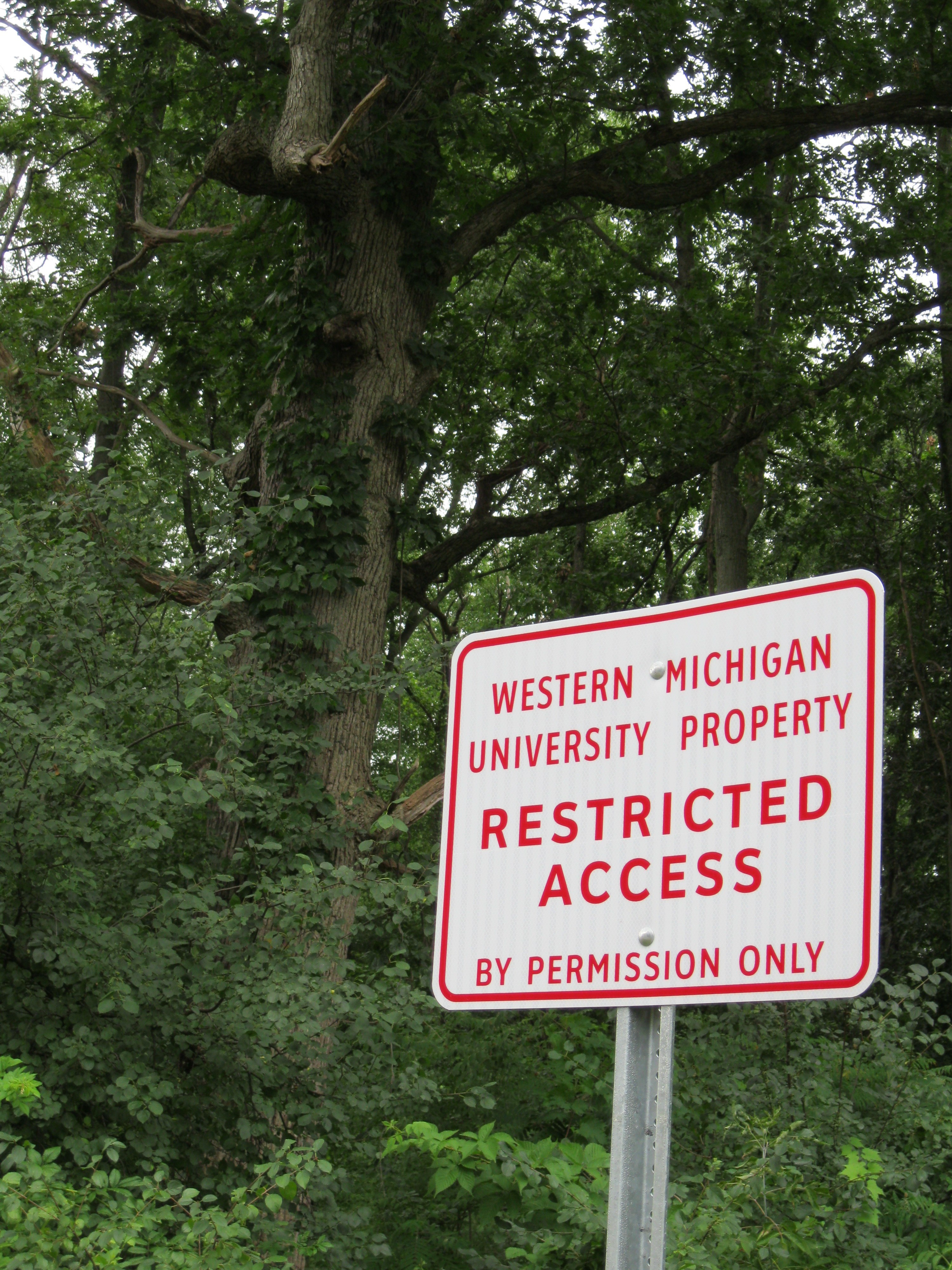
The Colony Farm Orchard's new signs. Photo by Richard Brewer

On 17 July 2010, David Nesius, a conservationist interested in retaining the Colony Farm Orchard as a natural area, noticed activity at the Orchard.  Workmen were installing new signs that read Western Michigan University Property RESTRICTED ACCESS  By Permission Only.

He spread the word via email about this new restriction on the public’s access to the land.

I was struck by the date on which the restricted access signs were posted.  On 16 July 2009, exactly one year ago, Representative Robert Jones introduced House Bill 5207.  This was the bill designed to strip the protective covenant from the Orchard land.  The timing of the legislation, some of us suspected, was designed to hide the attack on the Orchard as long as possible, occurring as it did when most students were away, many faculty were in libraries or at field sites scattered around the world, and many townspeople were on vacation.

Was the timing of the new signs a re-run of a successful gambit?  Maybe. I didn’t learn they’d gone up until I got back from a visit out East, so it kept me in the dark for a week.

On the other hand, the legislators who collaborated in dismantling the conservation covenant on the Orchard might wish that the signs had been delayed until after the August primaries or even the general elections in November.  Such a threatening display from WMU may bring back bad memories for some voters.

The Wednesday 21 July Kalamazoo Gazette carried an article by Paula Davis about the new signs.  She quoted WMU Associate Vice President for Community Outreach, Bob Miller, as saying that a concern for public safety prompted their installation. “We just want to know who is going to be there and what their plans are.  We’re not saying, ‘No Trespassing.’ We’re not saying, ‘Keep out’.”

When asked by reporter Davis how to get permission to be on the property, Miller said that people could “call the university and the university will direct them to the correct office.”  The Gazette article concluded with the university switchboard number.

Ladislav R. Hanka, local artist and conservationist, pursued the matter, finally talking with Donna Marks, executive assistant in the office of the Vice President for Advancement and Legislative Affairs.  After some discussion, it appeared that an email to Ms Marks (Donna.Marks@wmich.edu) containing one’s name, interest in the Orchard, what he or she would be doing there, when or how often visits might be, and who one’s companions might be would suffice.  Probably Ms Marks could provide further information if desired (387-2072).

Obtaining permission to visit the Orchard is highly desirable. Whatever the signs were meant to accomplish, they should not prevent anyone from continuing (or beginning) their bird watching, asparagus picking, snow shoeing, bur oak hugging, plein air painting, or any other other kind of nature, conservation, or environmental activity.

It’s well to remember that the Orchard land is still available for permanent protection.  Even though the open space/public use covenant has been removed, WMU is not compelled to expand the BTR park onto this land. It’s a fact that the original language of HB 5207 called for a new restriction that WMU would use the land for BTR Park expansion.  But after that language served its purpose as a more-or-less plausible justification for dumping the conservation covenant, the language was dropped, even before the bill left Representative Jones’s House Commerce Committee.

The upshot is that the WMU administration and board have the power to grant continued life to the Orchard, and they will bear the responsibility for any death sentence.

In the meantime, the Orchard land lives and participates in the ecological functioning of Asylum Lake Preserve.
Colony Farm Orchard: A Voter’s Guide

I sent the following to the Kalamazoo Gazette as a Letter to the Editor.  The Gazette’s automated response told me that publication could take up to 2 months, which would be a month after the primary elections on August 3rd.  So I’m posting it here, slightly modified.

To what I say in the letter, I would only add that electing politicians who were involved in passage of House Bill 5207 would be seen as, and would be, a validation of the whole process of breaking the covenant and setting the Colony Farm Orchard up for development.

By “the whole process,” I mean the sneaky introduction of the bill at a time when few students were on campus, most faculty were concentrating on their research in their labs or at off-campus sites, and many townspeople were on vacation.  I mean the way the politicians and WMU spokesmen substituted repetition of PowerPoint bullets for a debate on the issues.  And I mean the cynical marketing of development of these 53 acres next to Asylum Lake Preserve as Kalamazoo’s job creation solution, while giving a cold shoulder to remediated brownfields, in regional economic terms the logical location for BTR park expansion.

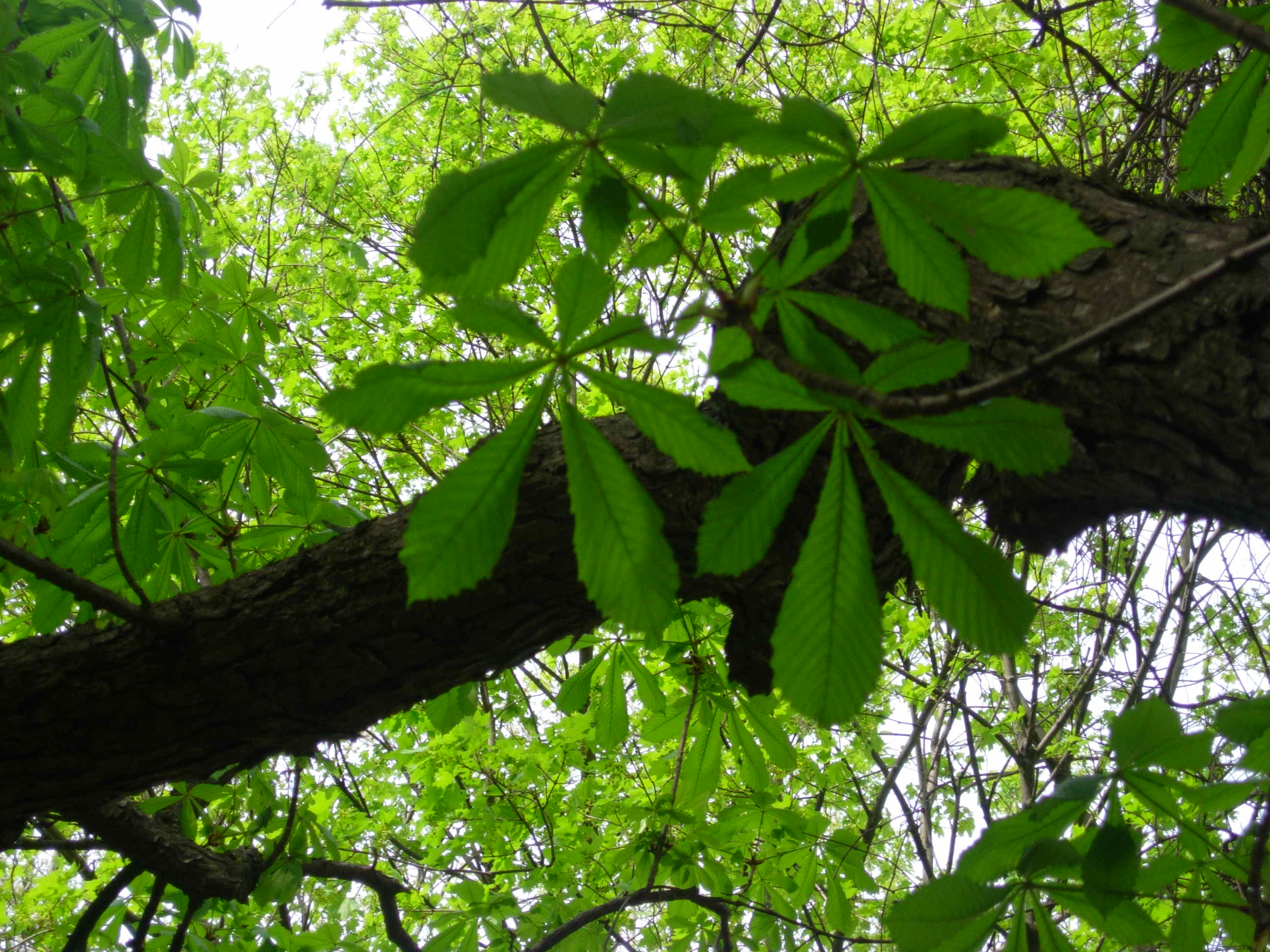
Horse chestnut tree, Colony Farm Orchard, spring 2010. Photo by Richard Brewer


Politicians whose names became notorious through their connection with House Bill 5207 are running again.

HB 5207 stripped from the Colony Farm Orchard the covenant that it be kept as open space for public use. Probably the most anti-conservation, anti-environment, anti-sustainability bill in the legislature last session, it fleeced us of dedicated open land and, if the land is developed, is a threat to Asylum Lake Preserve.

Most of us have a clear recollection of the events of 2009.  This recap is for those few who seem to have come down with a case of  early-onset political amnesia, as shown by a scattering of recent endorsements.

Robert Jones, let us recall, introduced HB 5207 July 16th, 2009 with no public notice from him or Western Michigan University at whose behest the deed was done. Jones is running again, this time in the Democratic primary for the 20th Senatorial district.  Fortunately, he is opposed by an excellent candidate, Mark Totten, untainted by the 5207 shenanigans.

And let us remember Larry DeShazor, who represented the District where the Colony Farm Orchard is located (in Oshtemo township).  He is running in Senatorial District 20 in the Republican primary. Neither Jones nor WMU had bothered to tell DeShazor about 5207; nevertheless, he voted for it in Committee and in the full House. His main Republican opponent is Tonya Schuitmaker, who also voted for 5207 in the House.

Tom George voted for 5207 in the Senate Appropriations Committee and in the Senate as whole.  Along with a bunch of other politicians, George is now running in the Republican primary for governor. In the Democratic primary is Andy Dillon, who allowed all this to happen while speaker of the House, and a second candidate, Virg Bernero, untainted by 5207 and as far as I can tell sound on other conservation issues.

Remember that the politicians who voted for 5207, local and otherwise, ignored an unprecedented outpouring of grass-roots sentiment against it.  But the letters, emails, phone calls, and personal visits were from conservationists, members of neighborhood groups, Environmental Studies students, and ordinary citizens who believe that promises should be kept–not the people these politicians are used to listening to.

And finally, remember that Jones or George and probably DeShazor, could have stopped 5207 dead in its tracks simply by saying to their colleagues, “I have concluded that this bill affecting my district is bad legislation.”

Should we put any of the supporters of 5207 in positions to do further damage?

Getting Maps Right for the Color-blind Naturalist

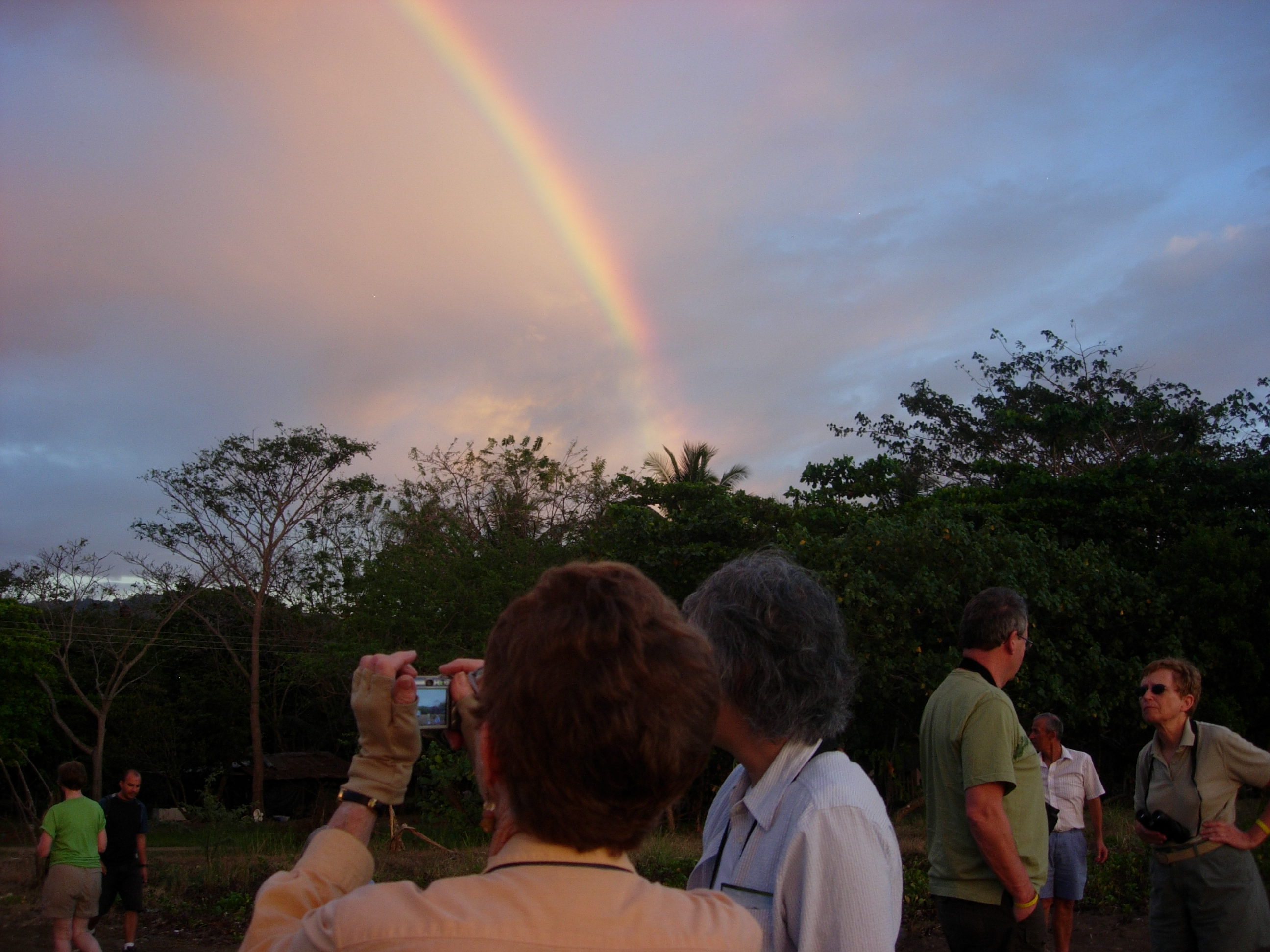
Rainbow at dusk near Tarcoles, Costa Rica, 17 February 2010. Photo by Richard Brewer

The January 2010 issue of The Auk published my review of the Atlas of Breeding Birds of Ontario, 2001-2005.  It’s a fine book. It may be a little heavy for some readers–it weighs more than seven pounds.

The next (April) issue of The Auk published a Letter to the Editor that made reference to the review.  The letter from Wayne E. Thogmartin (with the U.S. Geological Survey at its LaCrosse, Wisconsin, center) was prompted, he wrote, by “a peculiar aside proffered by the author.”  He then quoted the following passage from my review:

A word about the colors of the maps:  Like nearly 10% of males in the United States (a similar prevalence in Canada, I suspect), I have red-green color blindness.  Though it may seem unfair that maps and other color-coded graphics should be designed with 10% of one-half of the human population in mind, I suggest that it is unwise to design materials that will be unintelligible or at best ambiguous for this segment of the population. My wife, like 99% of the female population, has good color vision.  She informs me that the breeding evidence maps use the following colors–gold, orange, red, yellow, and dark gray (plus white). I can separate all these colors, whether I can identify them or not.

I have more trouble with the relative abundance maps; they use white, yellow, gold, light orange, orange, and red.  In areas where the abundance level marches in orderly progression from low to high, I can pretty much distinguish the six abundance classes.  But an isolated blob might require considerable study in very good light.

At least these maps do not intermix red and green.

The emphasis was added by Thogmartin.

He calculated that at 8% prevalence in the general (male) population, about 140 members of the AOU are likely to have red-green color blindness, or “color-vision impairment.” He went on to say, “Any failure to produce a color legend that is informative to the full spectrum of ornithologists is unfortunate,” because methods are available that allow map-makers to produce maps with color schemes everyone can interpret. He cited several sources that can be consulted by the map-maker who aspires to inclusiveness and social equity.

I’m indebted to Thogmartin for making my aside operational.  I admit I’m puzzled by his characterization of it as “peculiar.”  But it does seem odd, if not peculiar, that one of the most important students of getting map colors right for the color-blind, as cited by Thogmartin, is also named Brewer.  That would be Cynthia A., professor of geography at Penn State (no relation).

Cynthia A.  has an online tool for map design, ColorBrewer, that looks very useful for designing color schemes. On the other hand, just having the cartographer confer with a color-vision impaired person might do the trick almost as well.  The map Presettlement Vegetation of Kalamazoo County, Michigan (Thomas W. Hodler, Richard Brewer, Lawrence G. Brewer (also no relation), and Henry A. Raup, 1981, Western Michigan University Department of Geography) has a color scheme anyone can readily interpret because a color-vision impaired person (me) chose the colors for the cartographer.

I noticed a couple of days ago that the National Weather Service’s on-line radar maps have a downloadable Color Blindness Tool (located on the left side of the screen under Additional Info:)  On-line radar has always looked like multicolored hash to me, so I’m hoping the tool (Visolve) will prove usable and useful.