Monthly Archives: May 2010

Why are Yellow-headed Blackbirds rare in Michigan?

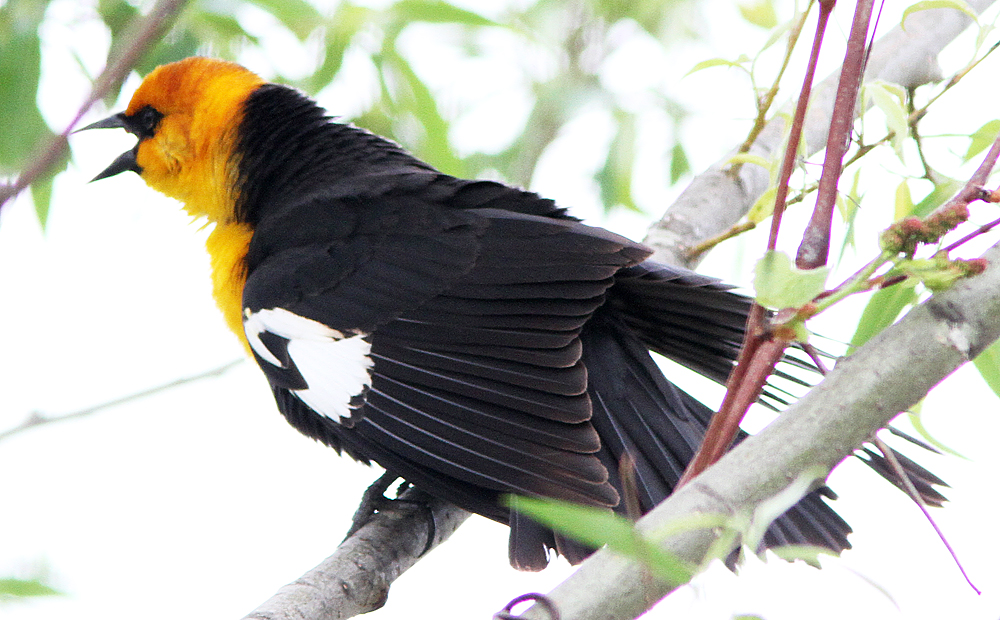
Male Yellow-headed Blackbird singing, Wolf Lake Fish Hatchery. Photo 1 May 2010 by Tim Tesar.

A Yellow-headed Blackbird, a rare bird in Michigan, was seen near the end of April at Wolf Lake Fish Hatchery.  The Fish Hatchery is west of Kalamazoo, a few miles over the Kalamazoo-Van Buren County line.  The bird was first reported on 30 April.   I drove out Sunday morning, 2 May, to try to get a look.

It wasn’t hard.  The bird was on territory, hence easy to locate, and also easy to identify with its bold yellow, black, and white plumage.  On the perched bird, the white is seen as a narrow stripe on his side, but when he flies it flashes as a sizable patch on the leading edge of the wing.  Females don’t have the patch, but there were no females evident.

I watched the bird fly back and forth between several perches, singing fairly often, occasionally chasing a Red-winged Blackbird.  Male Yellow-headed Blackbirds are handsome birds, but their song is not handsome exactly, or pretty or melodious–more like odd, but well worth hearing for its oddity.  The recordings readily available on the web don’t quite do justice to the long, loud, vibratory parts of the performance, but you can get a general idea from the example included at the Bird Watcher’s Digest website.

Yellow-headed Blackbirds tend to be polygynous and colonial.  I wasn’t sure whether one lone male would be able to attract a female but I was hoping he’d get lucky.  But as far as I know no female was ever seen, and by some time around the middle of May, the male was gone.

Michigan accounts of the Yellow-headed Blackbird tend to start with a statement to the effect that species is relatively new as a breeding species in the state. It’s true that the first confirmed nesting in the state didn’t occur until 1956.  Four birders visiting the Upper Peninsula in late June followed up a report of Yellow-headed Blackbirds in a large marsh in Gogebic County, a few miles from the Wisconsin border.  They found two males and five females and spent some time hunting for nests but didn’t find any. However, one of the birders returned the next morning and found two nests.

The finder of the nest was Larry Walkinshaw.  Who else would it have been? Walkinshaw was a Battle Creek dentist who was also one of the great field ornithologists of the era. Part of his research repertoire was a seemingly uncanny ability to locate nests.  I wrote about Walkinshaw in an earlier post.

Discovery of the first Lower Peninsula nest followed four years later.  A colony of seven nests at a cat-tail marsh in Saginaw Bay was found in early June 1960 by Bob Grefe and fellow birders in Bay County near Quanicassee.

By the mid-1980s (1983-1988) The Atlas of Breeding Birds of Michigan (Brewer, McPeek, and Adams, 1991, Michigan State University Press) showed confirmed nesting in 13 townships–4 around Saginaw Bay and 2 more not far away, 4 in the Upper Peninsula, and 3 in Muskegon County on the west side of the Lower Peninsula.  Six more townships had summer birds that were probably nesting, but confirmation was lacking, and 10 more townships had birds possibly nesting.  (The uniform breeding codes and criteria for breeding-bird atlases are here.)

These observations could fit a pattern of arrival as a breeding species in Michigan sometime in the 1950s followed by spread and establishment as a regular but rare and local member of the breeding avifauna in the next 30 years or so.  But in preparing the chapter “Original Avifauna and Postsettlement Changes”  (pp 33-58) in the first Michigan breeding-bird atlas, I realized that the view of Yellow-headed Blackbird as a recent immigrant was incorrect or at least incomplete.

The blackbird, I concluded, is one of a small group of Great Plains species that occur in the grasslands and grassland marshes and that extend their geographic ranges when there are severe droughts in the Great Plains. It seems likely that carrying capacities for these birds drop as ponds and marshes shrink and grassland habitats deteriorate. Surplus birds disperse, some coming east.

The important droughts of the 20th century were the Great Drought of 1933-1940 and the 1950s drought, which was most severe in the Great Plains from about 1953-1957.  The first recorded nests of the Yellow-headed Blackbird in Michigan came during the invasion of the 1950s.  What happened in the 1930s drought?

During and just after the drought years of the 1930s, Yellow-headed Blackbirds were seen in the breeding season at a few places around Michigan after being virtually absent through the early part of the 20th century.  No nesting was recorded, but nesting did occur just to the southeast, in Ohio, at a site that has since become much more famous for other reasons–Magee Marsh (Lucas Co.). Nesting was first confirmed there in 1938, but summering birds were present from 1934 to 1941. After that, no summer birds were reported from the area around Sandusky Bay until 1960.

What of other, earlier droughts?  As we go back in time, the ornithological evidence gets scantier but follows the pattern of a bird that, except for occasional stragglers, is only here in the eastern part of the Midwest during tough environmental times in the Great Plains (and for a few years thereafter).

Here’s some more evidence.

Morris Gibbs, one of Michigan’s earliest ornithologists, a Kalamazoo resident, and a very smart guy, wrote in the early 1890s that the Yellow-headed Blackbird occurred in extreme southwestern Michigan and probably bred.  This statement was discounted by most later compilers of Michigan bird lists, although a specimen, the first for Michigan, was taken on 17 May 1890 in the Upper Peninsula adjoining Wisconsin (Dickinson Co.).

What is definitely true is that the species nested commonly in the 1870s-1890s in the large marshes around Chicago, Illinois, including Indiana marshes very close to the southwest corner of Michigan. In the summer of 1871, one egg collector took over a hundred Yellow-headed Blackbird eggs in the marshes along the Calumet River in Indiana southeast of Chicago and within 30 miles of the Michigan line.

This period of relative abundance in northwest Indiana and possible nesting in southwest Michigan was a time of two 19th century  droughts, one in the 1870s, and one from the late 1880s to about 1896. Then, in the early 20th century, populations in the marshes of northwestern Indiana faded to zero.

The second drought, the one from the late 1880s to 1896, was the one that gave rise to the slogan, “In God we trusted, in Kansas we busted” and led to the sod-busters dispersing from their Great Plains farms like Yellow-headed Blackbirds from a dried-up prairie slough.

2.  As we’ve noted, the first Michigan breeding bird atlas documented a substantial Yellow-headed Blackbird population.  But the atlas period included the third and last of the 20th-century droughts (1987-1989).  So the comparative abundance of the bird at that time fits our model very well.

I mentioned that other species seemed to follow a similar pattern of breeding season occurrence in Michigan corresponding to a cluster of drought years in the Great Plains.  The others that I noticed were Wilson’s Phalarope, Western Meadowlark, and perhaps a few more, such as Western Kingbird and Brewer’s Blackbird.

I would add one more thing:  Michigan is as much a part of the geographical range of these birds as it is for the robins and chickadees that are here in numbers every year.  Droughts are an expectable occurrence in the Great Plains.  When habitats deteriorate there, the lakes and marshes of Michigan, Illinois, and Ohio are important refuges for birds that would fail to breed and possibly would perish if the wetlands of the eastern Midwest were unavailable.

Asylum Lake Preserve: What Kalamazoo ought to do, part 2

My last post several days ago repeated and updated some remarks I’d made on Earth Day 2004.   It ended with the following comment about the Asylum Lake Preserve situation at that time:

Today’s Gazette (24 April 2004) had more good news. After a long process, a Declaration of Conservation Restrictions and Management Framework for the Asylum Lake Preserve was approved last Friday by the Western Michigan University (WMU) Board of Trustees. This way of protecting such land is not as strong as a conservation easement held by a land trust provided with an adequate defense endowment. But all in all, I’d say that the Asylum Lake property is now more secure than at any time since 1985. Continued vigilance by area citizens will still be needed. In the long run, their outrage at proposed violations is the only permanent protection.

Asylum Lake Preserve Winchell Avenue entrance. Photo by Richard Brewer

These statements are still basically correct.  However, the passage of six years has shown some weaknesses.  Some are structural, stemming from the arrangement that was worked out by the 20-member Focus Group from 1999 to 2004, others are operational shortfalls.  Following are a few I’ve observed.

Omission of  the Colony Farm Orchard

The failure of the non-university members of the Focus Group to insist on the explicit inclusion of the Colony Farm Orchard in the Declaration of Conservation Restrictions was a mistake. However, it’s likely that some element of the WMU administration was already tightly committed to future development of the Orchard land, despite its protection by a conservation covenant. By 2004, the Focus Group had already been meeting for about five years. It’s possible that if the community and other non-university members had been as intransigent on this matter as they should have been–that is, as intransigent as WMU–any resolution might have been several more years away.

Weak Focus on Conservation

The Policy and Management Council set up to oversee the management of the Preserve seems to spend too much time dealing with house-keeping and not enough with conservation.  To an outsider like me, some of the causes for this seem evident, but there may also be other non-obvious reasons.  The first problem is that the composition of the council is stacked in a way that makes any action counter to the WMU administration’s wishes difficult or, perhaps, impossible.  The by-laws specify the composition of the board:

University Members
a. Campus Planning
b. Environmental Institute
c. Environmental Studies
d. Physical Plant
e. VP Business and Finance.
f. 3 At-large members selected by the VP for Business and Finance

Community Members
a. Asylum Lake Preservation Association (ALPA)
b. Environmental Concerns Committee of the City of Kalamazoo (ECC)
c. Kalamazoo Environmental Council (KEC)
d. Oakland Drive/Winchell Neighborhood Association (ODWNA)
e. Parkview Neighborhood Association
f. Parkwyn Village Neighborhood Association

A near-automatic WMU majority of 8 to 6 is built in, if all members are present and voting.  It could be argued that this is the way it should be.  After all, it’s WMU’s land; shouldn’t they be able to do what they want to with it?  Who knows what a bunch of community activists might vote for?

It’s conceivable that on some crucial environmental issue one or more of the University delegates might be persuaded by the arguments of the Community delegates, resulting in a tie or even a majority against the WMU position.  (Perhaps the Environmental Studies delegate might be swayed.) I don’t know that any such thing has ever happened, but it would be interesting to see the WMU administration’s response if it did.

However, my guess is that that the Council meetings will be models of seeming tranquility until such time as every appointee from the Community groups becomes willing to (1) engage the whole Council on every matter related to  conservation purposes, including matters being neglected, and (2) scrutinize and debate every proposal so as to eliminate those that fail to advance conservation mandates or are less than prudent in the use of the Asylum Lake Preservation endowment.

Examples

Sidewalk along Parkview Avenue (looking east) and new parking lot under construction. Photo by Richard Brewer

I do not question the seriousness or good intentions of the Council: nevertheless, I think some actions or the neglect of some actions needed more rigorous examination.  Here are a few examples.

Shrinkage of Preserve. Reduction in size of the preserve has occurred through such actions as widening Drake and Parkview, adding sidewalks which turned the outer acres of the preserve into narrow strips isolated beyond an 8-foot expanse of concrete, and the current construction of a large parking area within the main body of the preserve.  Although WMU refers to the Preserve as 274 acres, that’s what it used to be.  Someone should subtract the land lost and provide  an accurate figure. No more shrinkage should occur.  Explicitly including the Colony Farm Orchard as a part of the Asylum Lake Preserve would be one way to restore lost acres.

Proliferation of Trails. The preserve needs to regain control of its trail system.   The current network seems to consist of paths to everywhere any visitor ever decided to go. The proliferation  is confusing, it contributes to soil erosion, and it opens almost every part of the preserve to disturbance by people and dogs.  I suspect that few if any ground-nesting birds are able to bring off successful broods today.  Every path plus a several-foot zone on each side is, ecologically, a loss from the preserve.  Preserves need trails but they should be short, mostly narrow, and based primarily on considerations of environmental and nature education.

Extravagant and Unnecessary Construction. Some completed and proposed construction probably needed more debate more focused on conservation and prudence.  Of course, we all like to see the old Preserve looking good, but which of these projects have been necessary and a reasonable use of the endowment fund?

Colony Farm Orchard. The Council should have taken up the Colony Farm Orchard’s role in the ecological functioning of Asylum Lake Preserve. A series of special meetings would have been appropriate. After assembling the relevant information, including hosting a forum for public debate, the Council should have made its own recommendation to WMU as to the Orchard’s best use in terms of the conservation values of the Preserve.

How Secure is the Asylum Lake Preserve?

There were faint earlier signals that we should have heeded, but for many of us the alarm bells really began to ring when we read Paula Davis’s article in the 3 July 2009 Gazette reporting that the WMU board had authorized paying Michigan State University up to $985,000 to give up its lease to do insect research at the Colony Farm Orchard.

Possibly the WMU administration and board knew so little history that they didn’t understand how the citizenry would react to a threat to the Orchard property.  But to the many Kalamazoo area residents who had fought the BTR park battles of the 1990s, the news about the Orchard was like the crew of a WW II cruiser sighting a U-boat periscope in the North Atlantic. Somebody involved in the maneuver would seem to have anticipated a negative response, judging by the stealth involved in the introduction of the legislation (to strip the Orchard’s open space/public use covenant) and the attempt–successful–to hustle it through the House.

Many people were, of course, unhappy with WMU’s designs on the Orchard.  Their letters of protest showed that most of them also believed that WMU’s willingness to break this covenant was evidence that its pledge to protect the Asylum Lake Preserve was also suspect.

Was WMU surprised that people drew this inference?  Only the administration and board could say, and they have managed to say remarkably little through the whole process from July 2009 to the present. One thing WMU administrators have said, in various permutations, is,  “We have made a decision to sustain our commitment to the Asylum Lake property.” Sometimes the statements were more forceful, but few people I’ve met were persuaded by any of them. The very fact of the reiteration–coupled with the plain fact that WMU was disregarding identical protections carried  by the Orchard–usually provoked the “The lady doth protest too much” reflex.

Here is a quote from the Declaration of Conservation Restrictions:

This Declaration…is intended to run with the land and shall be binding upon WMU, its present and future boards, its successors and assigns and shall constitute a servitude upon the Preserve.

This a strong statement.  However, it is somewhat undercut by the next clause in the document, Termination:

The intention to terminate this Declaration must be announced at an open meeting of the Policy and Management Council (“the Council”). See Section 8 herein. A hearing on said intention shall occur at the next meeting of the Council, which shall be scheduled within a reasonable time. At least 15 days and not more than 30 days before any hearing to terminate this Declaration, WMU shall place a public notice in the major local paper noticing the public hearing of said meeting at which public comment will be allowed concerning the intention to terminate. The Council shall make findings of fact regarding said intention to terminate this Declaration. A vote to support termination shall require a 3/4 vote of the Council. The action of the Council shall be presented to the WMU Board of Trustees at its next scheduled meeting within Kalamazoo County and at which public comment shall be allowed.

So, how secure is the Asylum Lake Preserve?  We see that the Declaration can be terminated  by a 3/4 vote of the council followed by WMU Board action.  A 3/4 vote of a 14-member Council would require 11 yeas. It would take only four no votes to block it.

Might the Council vote to terminate?  You be the judge.  And you might ponder this question at the same time: If WMU proposed terminating the Declaration and lost in the Council, what would be the administration’s next move?

I’ll return to the status of the Colony Farm Orchard in a future  post.

[23 June 2010.  I rearranged the order of this post to make it more descriptive.]