I made the following remarks at the 24 April 2004 Earth Day celebration at Kalamazoo Valley Community College and included them on the earlier version of my website as Conservation Letter 2 . Today, in boldface , I look at the same topics six years later.
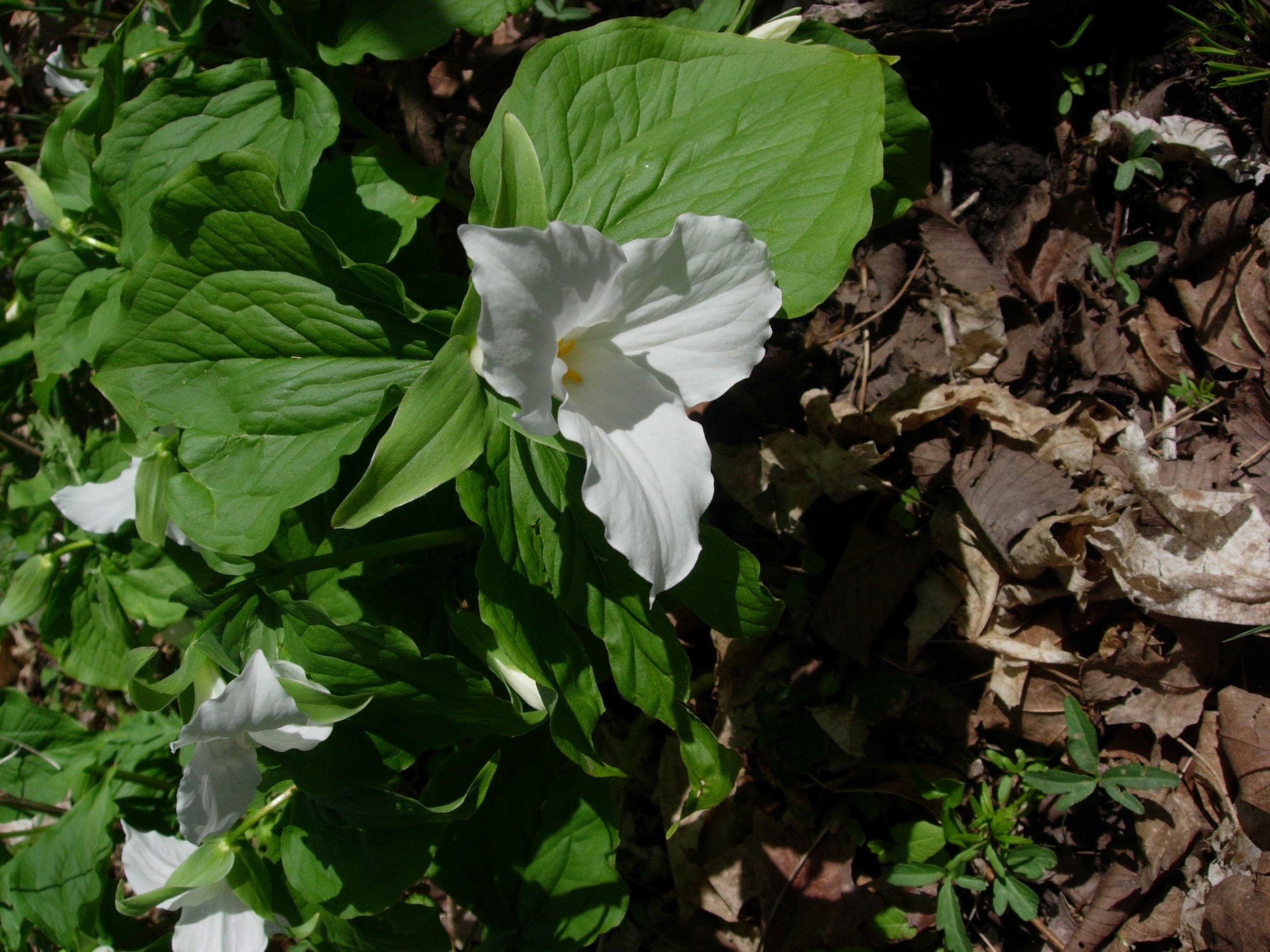
White trillium, Earth Day 2010. Photograph by Richard Brewer.
When I agreed to give a talk at Earth Day, I asked my wife what I should talk about. She said, “It’s Earth Day. Talk about positive, forward-looking things.”
“What should I call the talk?” I said.
“Use the title of the last chapter in your book.”
So today I’m talking about positive, forward-looking things going on in the area or the state, and the title is “A Cleaner, Greener Land.”
I added the subtitle myself.
A few months ago, I heard Dave Poulson speak just across the hall in KVCC’s Eye on Environment series. Poulson spent several years as the environmental reporter for the Booth newspapers, the only environmental reporter in the state as far as I know. He had just left that job to join an environmental journalism center at Michigan State University when he spoke here.
In his talk Poulson said that of all the issues he had reported on in his years of covering the environment in Michigan, he had concluded that the most important one, the central one where all the rest came together, was land use. As someone with a special interest in land conservation, I think that’s a sound conclusion, at least for the local and state level.
Today I’m going to mention a few hopeful land use actions that have been done or begun or at least been mentioned. I’ll also add a couple of other hopeful things that ought to be started.
1. First, I think this Earth Day is an encouraging sign in itself. I remember the first Earth Day in 1970 in Kalamazoo. Lew Batts spoke to a large audience at Nazareth College. [At the talk, I probably mentioned that there were smaller gatherings around the same time at Western Michigan University and Kalamazoo College.]
For the last several years, there has been no evident continuing civic commitment to Earth Day in Kalamazoo. Nevertheless, every year some group has stepped forward and put on something. I remember a couple of years ago, the Food Co-op, seeing that nobody else had planned anything, did the best they could in the space next to Kraftbrau.
2010–Continuing in the positive mode, it’s worth mentioning that the Kalamazoo People’s Food Co-op in these past few years has a remarkable record of success. I would say this is largely a result of (1) very good management and (2) the existence of a large constituency in and around Kalamazoo who want organic and local foods and who prefer to support this kind of organization instead of pouring their dollars into the pockets of large corporations. The success of the small Co-op store on Burdick St. has shown the need for larger quarters and, after long study, the Co-op is planning to build at the north edge of the downtown area, next to MacKenzie’s Bakery.
To the Co-op’s great credit, the new building will be on a brownfield site, which it is joining with the city in remediating. Also, the new downtown Kalamazoo link between the Kal-Haven trail and the Kalamazoo Riverfront trail will run right by it. Potentially, people could walk or bike to the new store from Portage, Battle Creek, or South Haven. (Unfortunately, people living in downtown Kalamazoo will have a longer walk than they do to the Burdick store.)
The Co-op is raising money for the project starting with its members. It’s a worthy cause.
The groups that I know of that have been working on Earth Day this year are the Kalamazoo Environmental Council and KVCC. I’m sure representatives of other groups and just plain individual environmentalists have contributed also. Today gives every indication of being one of the best celebrations in a long time, but just the fact that official neglect hasn’t managed to kill off Earth Day in Kalamazoo has to be seen as a hopeful sign.
2010–More recent Earth Days have had, as far as I could tell, little or none of the coordination of events among the various groups that was evident in 2004. This is unfortunate but perhaps understandable considering the absence of any city or county sponsorship. However, the number of events and activities have continued to expand, with more and more groups doing their bit for Earth Day.
Earth Day is, strictly speaking, 22 April, but Earth Day events have spread to the weekends before and after the 22nd, and even beyond. Nevertheless 22 April is the date in 1970 that the first of these national teach-in on the environment was held. Senator Gaylord Nelson (D-Wisconsin) was the originator. I hadn’t remembered until I read a little Earth Day history recently, that his inspiration came from the Viet Nam war teach-ins that had begun around 1965.
2. The biggest story on the front page of the Kalamazoo Gazette a month or so ago (28 March 2004) had the headline “Highway Upgrades Bypass Schoolcraft.” It’s one of those typical newspaper headings that don’t tell you what the article is about. What the story said was that the Michigan Department of Transportation has for the time being given up any plans to study, then plan and build a 4-lane $250 million 131 bypass around Schoolcraft.
This was not news; MDOT had made the announcement in December 2003. The reason is that there’s no money for new highway projects these days because of the poor economy. The Gazette article admits this but also spins the story to blame the people in the region for not embracing the idea of a bypass years ago.
The postponement is good land use news. Any of the bypass routes would eat up farmland that is probably the best in the state. Most of the routes would also destroy woods and marshes and would obliterate landmarks and relicts of Prairie Ronde, the 20-odd square miles of tall-grass prairie that once occupied the land around Schoolcraft. The bypass itself, depending on the exact route, could be four miles long and would occupy perhaps 600 acres and disturb much more in the construction. Interchanges and later business development would knock out additional acreages of farmland and natural land.
Only total cancellation of the whole idea of having a four-lane expressway all the way from Cadillac to the Indiana border would be better news for farmers and all opponents of sprawl.
2010–The Michigan Department of Transportation has not given up its dreams of a 4-lane highway to Nowhere, Indiana, as yet. Most recently, it has been talking about a bypass around Constantine. The only thing lacking is the money–well, the money and a legitimate reason for spending it this way. The project would cost $22 million, or probably more, which MDOT doesn’t have. But by using other money, MDOT has started environmental impact studies, preliminary engineering, and land acquisition. About 50 parcels of land will need to be bought, just to get around Constantine.
The economic downturn and lower gasoline usage mostly because of high gas prices have again spared Michigan the additional environmental degradation that would occur with a conversion of US-131 to an expressway all the way from Petoskey to the Indiana line. But we’ll never be safe from the threat as long as Michigan retains, where a Department of Transportation ought to be, a Department of Concrete Six Lanes Wide.
If “transportation” was really MDOT’s mission, its public statements would not be 98% about yet one more new highway or one more highway widening. Rather it would also be busily dealing with questions of mass transit, bike trails, sidewalks, passenger trains, and how best to achieve transportation objectives without damaging natural areas and farmland. When it did talk about highways, it would talk about keeping the ones we have in good repair.
3. Today’s Gazette had more good news. After a long process, a Declaration of Conservation Restrictions and Management Framework for the Asylum Lake Preserve was approved last Friday (16 April) by the Western Michigan University (WMU) Board of Trustees. This way of protecting such land is not as strong as a conservation easement held by a land trust provided with an adequate defense endowment. But all in all, I’d say that the Asylum Lake property is now more secure than at any time since 1985. Continued vigilance by area citizens will still be needed. In the long run, their outrage at proposed violations is the only permanent protection.
2010–I’ll update the Asylum Lake/Colony Farm Orchard situation in my next post. In it or later posts I’ll also cover points 4-7 of the original talk.


