Monthly Archives: March 2010

Kalamazoo County Spring 2010, Second Installment

I wrote the following last night.  Today, temperatures jumped into the 70s–77 as I write this at 6 PM.  The forecast is for highs in the 70s and 80s for the next three days.  So much for stretching out the spring.
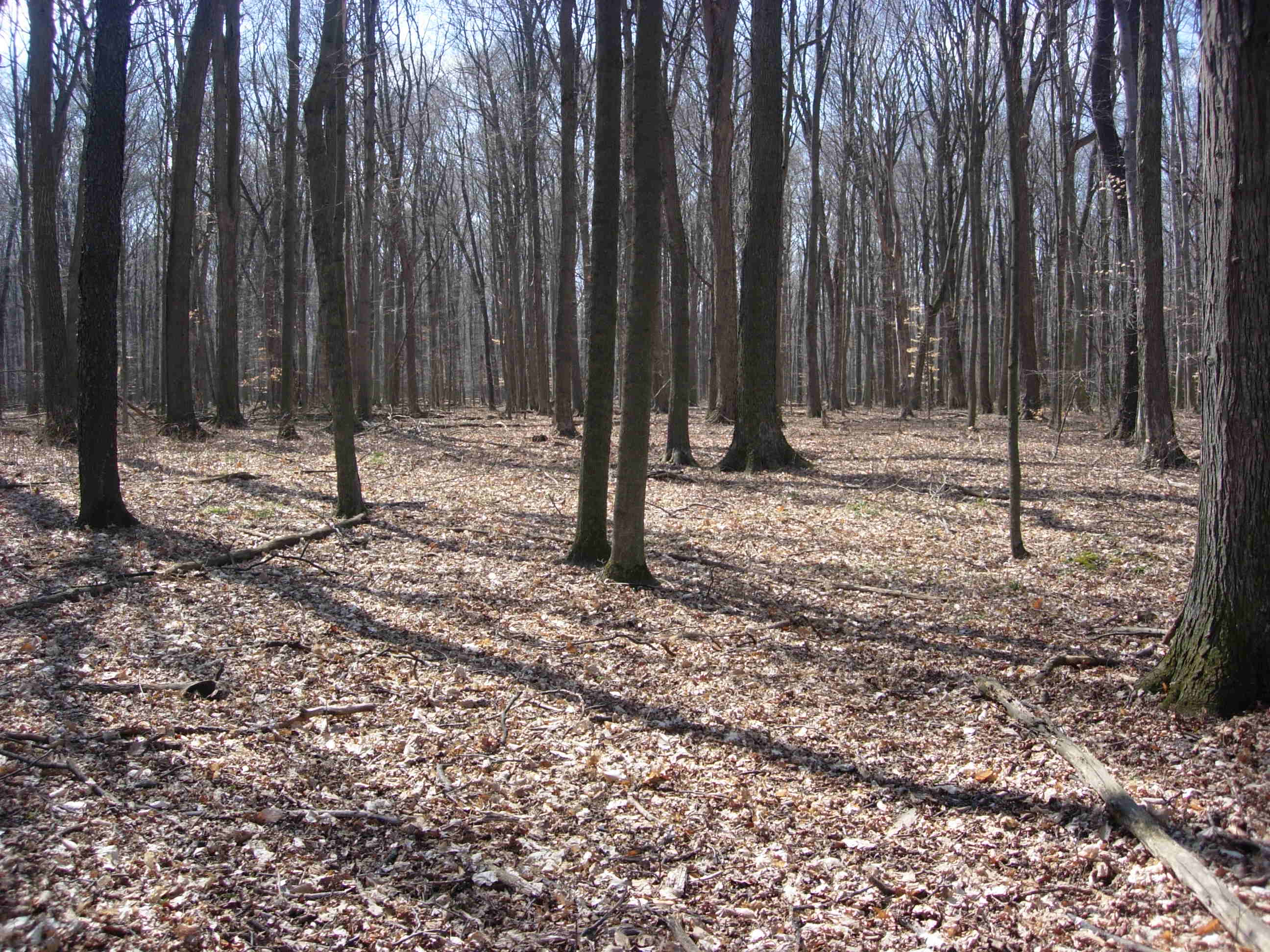
Beech-maple forest in early spring, Pavilion Township. Photograph by Richard Brewer.

A stretch of chilly weather, especially some cool nights below freezing, has kept spring from racing ahead the way it sometimes does.  This is good; summer is a fine time, but there are lots of things to experience in spring and it’s more fun to have them spread out rather than all happen in a week.

When I wrote my last post, no frogs had been calling as yet, but soon after, the afternoon of 17 March, wood frogs were calling in the small kettles such as the one shown in the preceding post.

Finding another sound to match any animal’s voice is difficult.  But saying that wood frog calls sound like the feeding chuckle of ducks is not a bad comparison. The frog calls are a little louder, I think, and each one sounds quite fervent, unlike the kind of absent-minded noodling of a bunch of dabbling ducks. But the comparison is a pretty good way to give other people an idea of what wood frogs sound like.

I have heard no chorus frogs or spring peepers yet.  We usually think of these two as the earliest frogs here in eastern North America, but some years wood frogs have been earlier in my experience.  I’m not sure, though, that–for whatever reason–peepers and chorus frogs aren’t rarer than they used to be.

Another animal that I believe was decidedly less common the past few months than in preceding years is the white-footed mouse.  I don’t go out and census mice in the woods; I base this impression on how many mice I trap each winter in the house.  The house here in Oshtemo Township is in oak forest. Beginning when the nights start to get cold, the mice start to find ways to get inside.  I trap them with ordinary mouse traps baited with a little peanut butter with a couple of sunflower seeds stuck in the peanut butter or inserted elsewhere on the trigger of the trap.  Most winters I trap a couple of dozen white-footed mice.  This winter I caught a couple of mice early on and then no more through most of November, December, January, and February.  I also set traps in my house in the southeast part of Kalamazoo County, in beech-maple forest.  Most years I catch several mice through the winter, but this past winter only a couple.

I don’t know what may have happened to the mice this winter and I don’t know whether it’s temporary or a permanent decline.  Next fall and winter may give me a clue.

Floerkea proserpinacoides, False Mermaid Weed, Big Island Woods, March 30, 2010. Photograph by Richard Brewer.

But that’s getting ahead of ourselves.  It’s early spring.  The wood frogs are calling.  In the beech-maple forest, harbinger of spring, our earliest spring wild flower is finishing up (a blog called Kalamazoo Seasons has a nice photo of the flower). The very first spring beauty flowers have opened. Wild leek is up.

And the little annual Floerkea proserpinacoides with its pale-green narrow leaflets is spread profusely over the ground in the few woodlots where it occurs, but is not quite in bloom yet.  This odd mesic forest specialist deserves a better vernacular name than the obscure, bookish “false mermaid weed.”  Maybe we need a contest for a new, better-fitting name for it.

Anyway it’s spring and will be for a good month yet, maybe longer.  Let’s enjoy it.
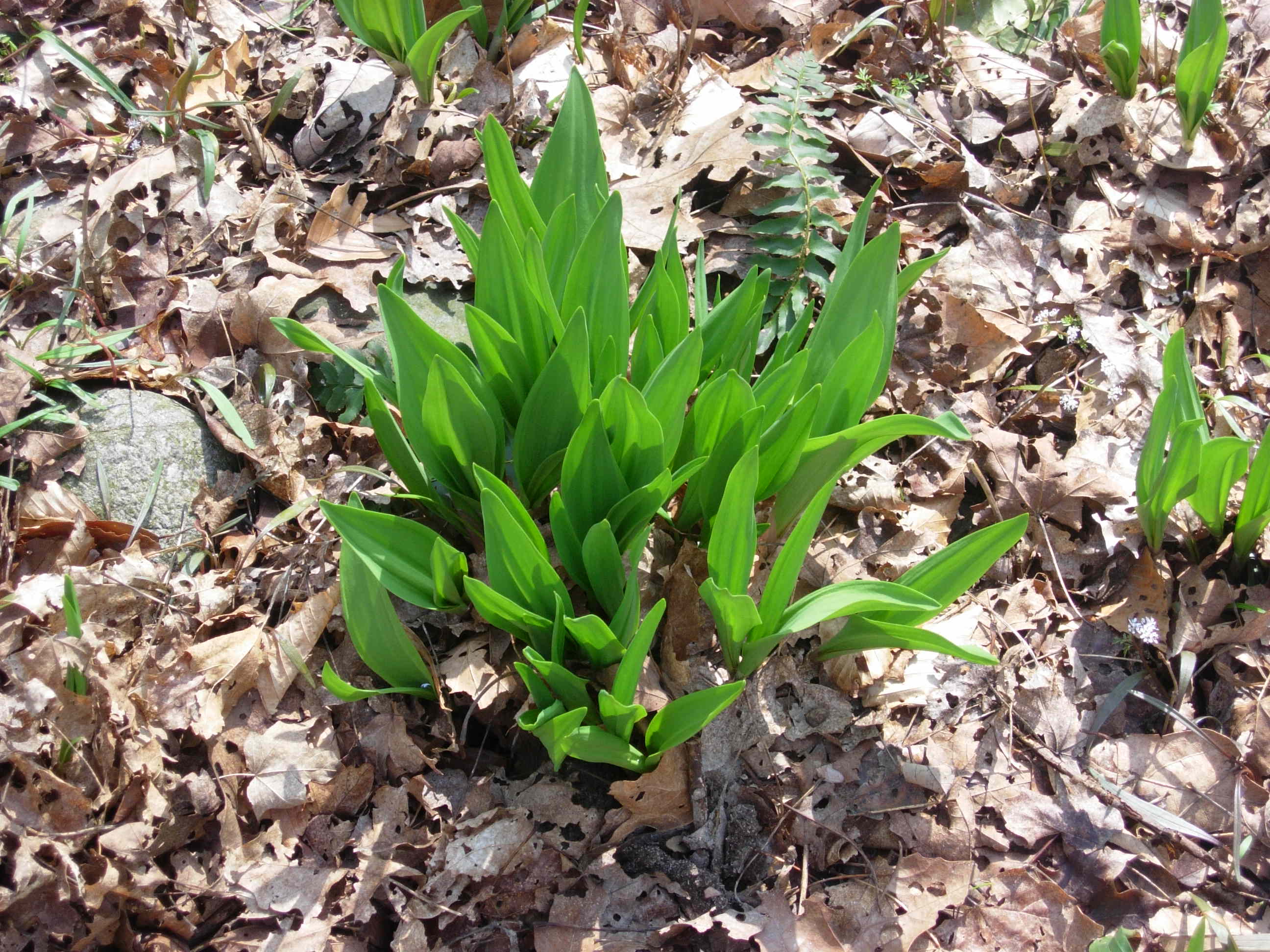
Leaves of wild leek, March 2010, Pavilion Township. Photograph by Richard Brewer.
Signs of Spring

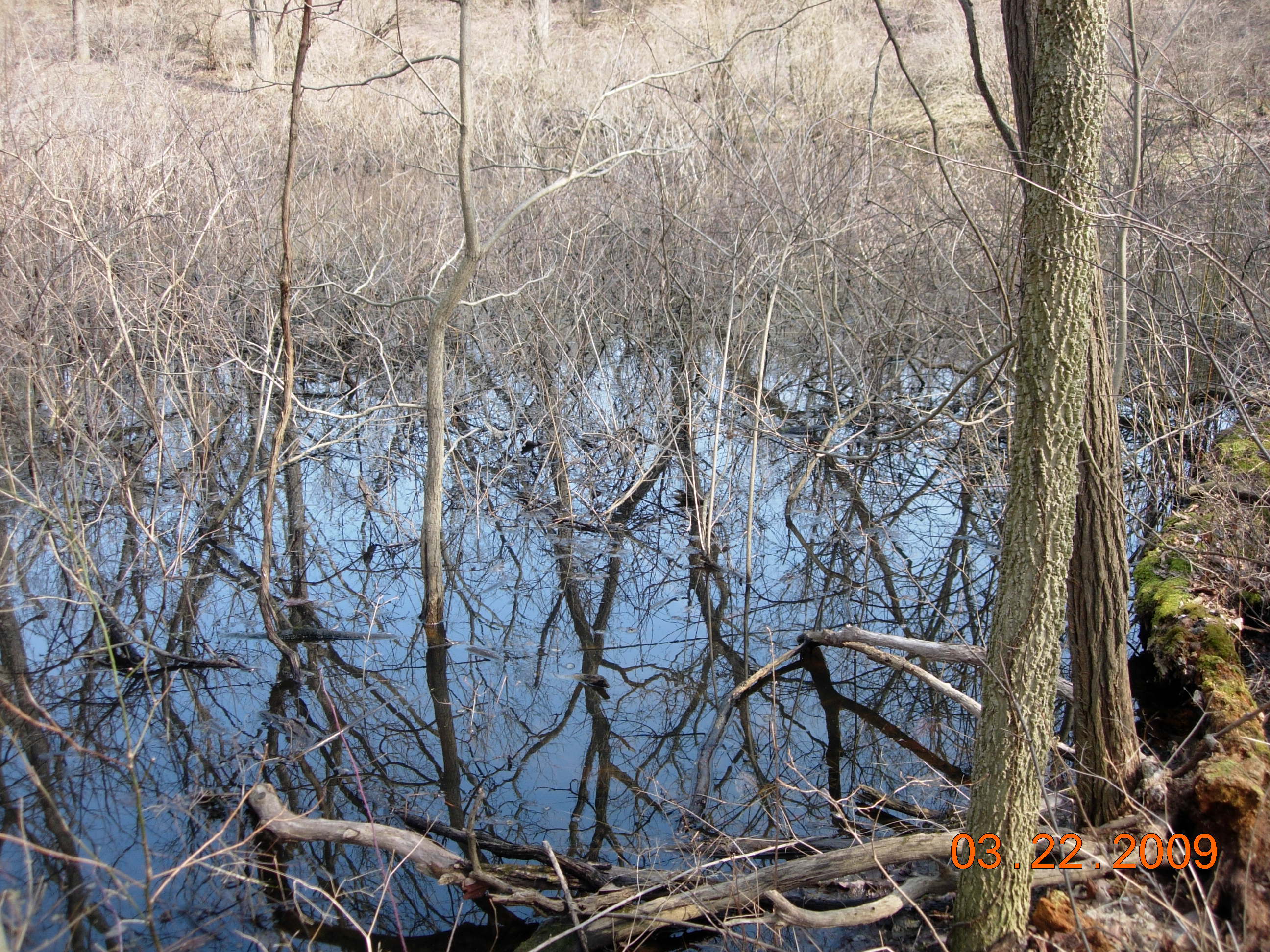
Open water in March in a buttonbush swamp, Oshtemo Township. Photo by Richard Brewer.

Spring began in southwest Michigan in the past few days.   One sign has been the Sandhill Cranes overhead, giving their loud rattle.  They could be on their way north or they could be local birds; several pairs now nest in Kalamazoo County.

Because snow cover was so continuous, and thick, some birds that are usually here by February were mostly delayed into early March.  The cranes are one species, Red-winged Blackbirds are another. I saw my first redwing a few days ago and they’re now pretty well scattered over the countryside.

In Pavilion Township Saturday, Song Sparrows were singing, Horned Larks were on territory in the open fields, and sailing overhead was my first Turkey Vulture of the new year. First in Michigan anyway; we saw Turkey and Black Vultures every day in Costa Rica. Most were probably resident there, but some could have been wintering birds from North America. This morning I saw my second Turkey Vulture sailing above West Main in Oshtemo Township.

I haven’t heard any frogs calling yet, and chilly as it is I don’t expect any tonight, but warmer weather is predicted for tomorrow.

As soon as bare patches began to appear around houses, the early spring bulbs were visible, some flowering.  I’ve already seen winter aconite, snow drops, and crocuses in bloom without hunting very hard.  Our native early spring wildflowers grow mostly in the mesic deciduous forests, and many of them are spring ephemerals–they come up, bloom, and then die back, so for most of the year they’re invisible above ground.  Right now the beech-maple forests probably have harbinger-of-spring in flower, and in the wooded low spots currently occupied by temporary vernal pools, skunk cabbage flowers will be out, though perhaps not producing pollen quite yet.

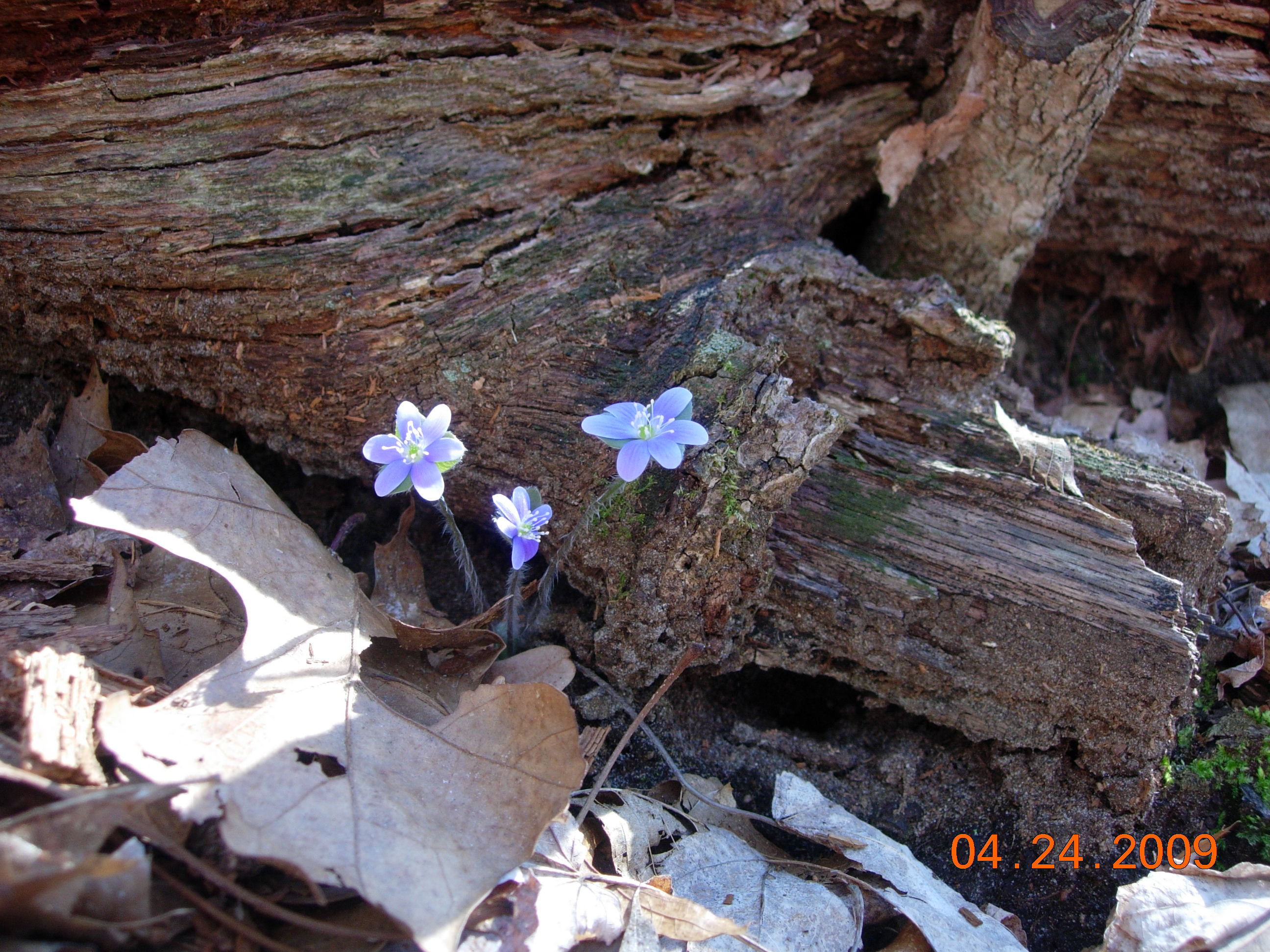
Acute-leaved hepatica, an early spring wild flower, but not a spring ephemeral. Photographed in an Oshtemo Township oak forest by Richard Brewer.

Our native early spring flowers take advantage of the brief window of full sun that opens between the arrival of warmer weather and the closing of the forest canopy by sugar maples.  It would make sense that the cultivated spring bulbs we buy and plant might be the early spring flowers from the deciduous forests of other parts of the Earth, but that isn’t the case.  Rather, most of the spring bulbs blooming in our front yards come from the steppes or the alpine and sub-alpine meadows of the Middle East and Asia.

The seasons follow one another in a continuous cycle.  A year has no natural beginning and no end.  Several groups of ancients gave the winter solstice, around December 21, special significance because it was the day they were reassured that the sun was actually coming back for another year. Our New Year’s Day, January 1 is arbitrary but since it comes not too long after the solstice, it’s not wholly unsatisfactory as a starting point in the cycle.

To me, though, the first definite signs of spring in nature, the sorts of things that have happened in the past week or so, feel like the engine of the year starting up.  In our temperate latitudes, this is the start of the year’s organic production; photosynthesis really gets underway, storing sunlight that, passed on along the food chain, runs nearly the totality of the living world. For a high percentage of the creatures here, spring is the time for beginning reproduction as well as production.  Eggs hatch and babies are born, and young of the year having new combinations  of genes not quite the same as either parent go out to become part of a later generation–or not.

Spring has arrived in southwest Michigan–I think–and a new year has started.  Happy New Year!

Costa Rica in the Dry Season, February 2010

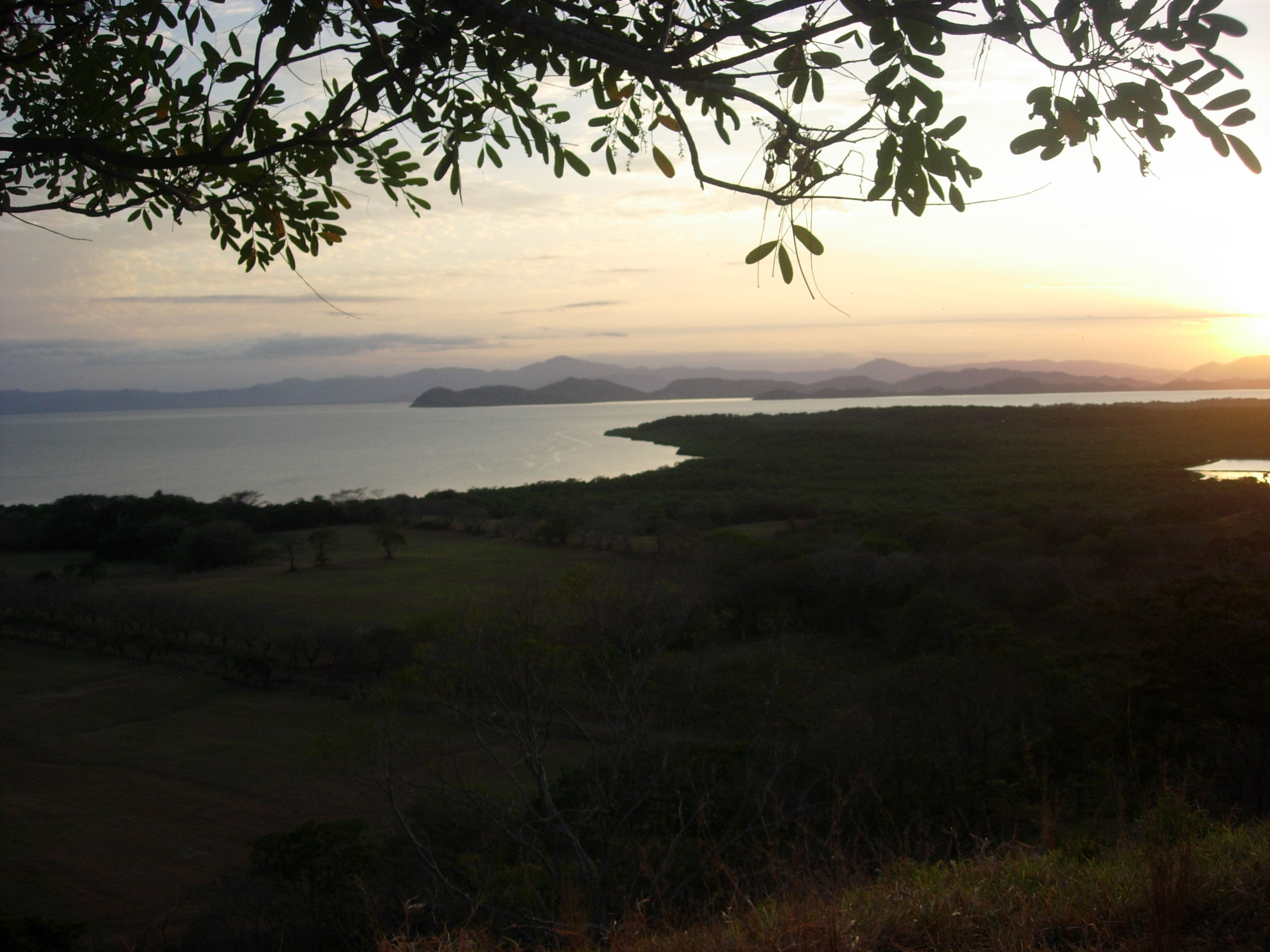
Friday night sundown, Gulf of Nicoya, from hilltop at La Ensenada. Photo by Richard Brewer.

Katy and I just returned from two weeks in Costa Rica.  As part of an Elderhostel–though the program is now called Exploritas–we visited five sites ranging from mangrove forest along the Pacific Coast to the rather chaparral-like vegetation called paramo around 11,000 feet above sea level on Cerro de la Muerte.  Included were visits to several important conservation areas, including  La Selva (and Selva Verde) and a site in the Savegre River valley.

Spending eight or more hours a day in the field, our group identified, or had identified for it, about 280 species of birds.  On one night excursion we heard and saw the Common Pauraque (but no potoos).  We also saw 2- and 3-toed sloths, howler monkeys, collared peccaries and a few other mammals plus various herp species including crocodiles and caimans, 2 species of iguanas, several other lizards, a few frogs, and the cane toad, native here but with a bad reputation in places where it has been introduced, like St. Croix, US Virgin Islands.

Interest in resource conservation is high in Costa Rica.  For one thing, ecotourism, which is what we were participating in, is a major element in the nation’s economy.  The subjects of ecotourism’s costs and benefits and how sustainable it is are complex, but as an incentive for setting aside natural lands, the impact has been positive and powerful.

At Selva Verde. Photo by Richard Brewer.

I’ll write more about our observations and experiences.  For now, I’ll say just that they involved a lot of interesting and beautiful wildlife and plants, spectacular scenery, lots of good food, and good company.