Monthly Archives: February 2010

Colony Farm Orchard: A Time for Knowledge, Wisdom, Conscience

Large maples, Colony Farm Orchard, fall 2009. Photo by Richard Brewer

The Kalamazoo Gazette for Sunday 14 February carried a Viewpoint I wrote which they titled WMU can keep orchard in natural state.  It had been altered slightly, improving the message in some ways.  Nevertheless, I prefer the version below. Posting it here may also be useful to those who missed the piece in the Sunday paper.  It was on the first section’s back page, which was otherwise totally occupied by a large advertisement for a heartburn medication.  But I was grateful to the Gazette for fitting it in anywhere and continue to regard newspaper conservation as a cause almost as important as land conservation.

Neighbors, WMU Alumni and Friends, and All Others Interested in Conservation: All that is required for the Colony Farm Orchard to be saved is for the WMU President and Board of Trustees to decide to set it aside as conservation land. Nothing prevents this. Please send President Dunn your recommendation. Do this now, even if you have contacted him before to provide current sentiment.

What should happen to the Colony Farm Orchard? House Bill 5207 said nothing about this question. The bill’s only effect was to remove the restriction that required public use for open space. Now that WMU can do whatever it likes with the land, the question becomes, What is the right use?

Feelings of local conservationists have been growing more antagonistic for seven months–feelings that they were kept in the dark by WMU, stone-walled rather than engaged in dialog, feelings that the attempt to remove the conservation covenant was in itself a betrayal of public trust, and feelings that the legislature and governor snubbed an outpouring of grass-roots sentiment that every civics class says is an essential element in our system of government.

People are also unhappy with WMU’s campaign based on a claim of job creation.  With able and willing citizens out of work, thoughtful critics see “job creation” as a cynical fiction, since the claim makes sense only if one realizes that jobs would be few, several years away, and bought at heavy expense to WMU and tax-payers. There is plenty of expansion room at the old BTR Park and then, if ever needed, at ready and waiting brownfields.

But all this is water over the dam.  Now that the WMU board and administration can do anything with the land, what should they do?

If the land could talk, it would likely say that its best use is pretty much what it’s been doing.  The Declaration of Conservation Restrictions for the Asylum Lake Preserve adopted by the WMU Board in 2004 states as its first goal promoting ecosystem integrity by maintaining the Preserve as green space and wildlife habitat and protecting natural features from further degradation.

If the Orchard were developed, WMU would be abandoning the last two aims. Development would diminish the Preserve; its status as wildlife habitat and its natural features would be degraded. Wildlife populations at Asylum Lake would fluctuate more, some would decline, and some declines would end in local extinction. It is easy to underestimate the Orchard’s role in the functioning of Asylum Lake Preserve. The Orchard and the Preserve are ecologically connected.

Ron Sims, the new U.S. Deputy Secretary of Housing and Urban Development, was known for preserving open space in his last job in Seattle as County Executive of King County.  He had come to realize that protected natural areas and open space are as important for the lives of the urban dwellers that were his natural constituency as for others. First-hand experience with natural land is valuable for everyone, but even when people are unable to visit the land, it enriches their lives by providing a great variety of services whose effects extend tens, hundreds, or thousands of miles. Included are things as simple as nurturing birds and butterflies any of us can enjoy in the sky and as complex as participating in the global carbon cycle.

Though the restrictive covenant on the Colony Farm Orchard is gone, the land is the same, still providing essential ecosystem services to the Preserve and to all of us, and still deserving permanent protection. The only difference is that now the protection will have to come from knowledge, wisdom, and conscience on the part of the WMU board and administration.

Email address: john.dunn@wmich.edu. US Postal address: President John Dunn, Western Michigan University, Kalamazoo, Michigan 4908-5202.

If you wish, you could send a cc or a note to colonyfarmorchard@gmail.com, to let others who wish to save the Orchard see your views.
Colony Farm Orchard Art by Lad Hanka and Others at KNC

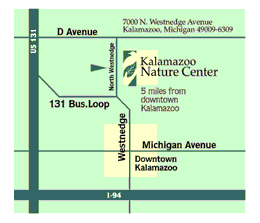
KNCMapBeginning this weekend the Kalamazoo Nature Center will feature an art exhibition that includes images from the Colony Farm Orchard.  The show, entitled “Sacred Trees,” includes prints by Ladislav R. Hanka and paintings and photography by Sniedze Rungis and Zaiga Minka Thorson.   The opening is Sunday 7 February 1-3 P.M.

Lad Hanka, a Kalamazoo artist with strong natural history interests, has been one of the leading proponents of the view that the Colony Farm Orchard should be maintained as open space.  A 19 July 2009 email, sent by him to several  local conservationists began, “A significant portion of the Asylum Lake Preserve is in imminent danger of destruction. The threat is real as I shall outline below…”

KNC is at 7000 N. Westnedge on the right side of the road.  The show will be in the Glen Vista Gallery.  Cross the bridge, veer right at the entry desk, and go south through through the natural history exhibits to the windows looking out into Cooper’s Glen.

The show will be up until March 26, 2010.

Here are a few lines from Lad Hanka’s introduction to the exhibit, “Drawing Sacred Trees at the Colony Farm Orchard.”

In this exhibition, it is the Colony Farm Orchard from whose embrace I have been spiriting out my images.  That property is actually public land and protected by legislative deed restrictions, but that no longer means much.  This place too has been fenced off and gated in order to usurp and eventually sell it off in parcels to private industrial developers.  It sounds as far fetched as a bad spaghetti western, but it is unfortunately the truth.

I’ve been entering the orchard across the scar of Drake Rd., only recently still shaded by centennial bur oaks.  With pencils in hand, I climb the fence, always fearing that I am just a step ahead of the bulldozers and the last to see it intact.  I record the forms of the remaining bur oaks and the hollow, aging apple trees, each cleaving the heavens with its signature branchings – and know that I am transcribing a primal calligraphy – the notation of a poesy far older than the forebrain with which I describe it.

The Orchard is a rare place within the city – a place to be alone without having to drive. The apple trees I‘ve been observing here for these thirty years have grown only more remarkable as they’ve become individuated in their old age.  Killing them and ravaging the earth that supported them is hardly an appropriate response.   Drawing them is.

My Colony Farm Orchard Letter to Mark Brewer

A few days ago I received a letter from Mark Brewer (no relation), Chair of the Michigan Democratic Party.  A good many thousand others received the same letter, I expect.  It began, Dear Richard, said 2010 is a crucial year, and asked for some money.  Here is the answer I sent.

2 February 2010
Dear Mark,

I received your letter soliciting a donation for the Michigan Democratic Party.  I’m unable to support the Michigan Democrats because of their performance in allowing passage of House Bill 5207.  It was introduced in the House in July 2009 by Representative Robert Jones (D-Kalamazoo) at the behest of Western Michigan University.  The bill, which stripped open space/public use restrictions from a parcel of land (the Colony Farm Orchard) conveyed to WMU in 1977 was anti-conservation, anti-environment, and anti-sustainabiity.  It should never have been written.

Although it appears that every attempt was made to slip the bill into and through the legislature without public knowledge, some local conservationists got wind of it and managed to show up at the House Commerce Committee hearing (chaired by Representative Jones). At the hearing and throughout the whole process, WMU attempted to sell the bill on the basis of jobs creation. Its claim was that this land, this specific land, was needed to expand their “Business Research Technology” park.  The claim was largely bogus since the park isn’t full and remediated brownfields that would make better sites are plentiful in Kalamazoo–to mention just two reasons why killing the open space/public use covenant was unrelated to any job creation. More about the subject is available in this post, and others before and after.

The bill sailed through the Commerce Committee and the full House, where it received only 2 nays, both Republicans.

By this time, local conservationists and neighborhood groups had gathered themselves. The Senate as well as Governor Granholm were besieged with messages asking that WMU’s effort to remove the restriction be voted down.  The Republican leadership of the Senate held the bill up for about three months but in the end brought it up late at night just before the Christmas recess.  It passed with only one nay vote, again by a Republican, Alan Cropsey, who made the point that he was voting against it because of its anti-conservation nature.  All the Democratic Senators voted for the bill, except a few who took to the hills when the time to vote came. This does not make them poor politicians; after all, this was a job creation bill, wasn’t it?

But it does make them politicians that I do not care to support monetarily or otherwise. The same goes for Governor Granholm, who signed the bill in early January 2010.  Governor Granholm made no comment on the bill, as far as could be determined. What could she say?

The outpouring of grass-roots opposition to the bill was remarkable and could not have been missed by anyone of either party in the legislature or by the governor.  No politician of either party who did not vote against the bill deserves the support of anyone who sees land conservation, keeping promises, or paying careful attention to legislation as priorities.

Sincerely

Richard Brewer