Monthly Archives: January 2010

Colony Farm Orchard: Can The Land Abide?

I sent a slightly different version of this essay to Western Michigan University’s student newspaper, the Western Herald on 17 January 2010 [Published 20 January with title Reps. Jones, George could have protected Colony Farm Orchard.]

004The Herald correctly reported on 10 January 2010 (online, 11 January print) that Governor Granholm signed HB 5207 recently.  The bill removed the restriction that the Colony Farm Orchard should be used for open space, public park, or recreation or, by legislative action, could be used for some other public purpose.  The effect of HB 5207 was to kill that covenant, potentially allowing WMU to use the land for anything, without asking anybody.

The Herald story listed a few of the many people who share the blame for stripping the conservation covenant.  Listing all would make a long story–and a long letter–but Kalamazoo’s two elected legislators should be given special recognition, because either could have stopped the process.  Representative Bob Jones (D-Kalamazoo) could have said no when WMU handed him the bill.  He could have said yes when conservationists asked him to withdraw it from consideration.  He did neither.

Senator Tom George (R-Kalamazoo) could have killed the bill at any time during the months it sat in the Senate.  A word from him would have been a death sentence because of the convention in the legislature of deferring to the position taken by the Senator from the affected district (professional courtesy–so to speak).  But Tom George did not say the word.  In fact, his position as given by the Herald is that as times change, so should laws and deeds.

This catches precisely the difference between the exploiter mentality and that of the conservationist–the difference between the polluters, clear-cutters, and  mountaintop blasters, on the one hand, and Teddy Roosevelt and Aldo Leopold on the other. It is the mentality that would make permanent protection of any conservation land impossible.  The times have changed, says the exploiter; we’ll change the laws, we’ll change the deeds. This natural land is now expendable.

It’s a mentality to reject.  Though the restriction on the Colony Farm Orchard is gone, the land is the same, still providing essential ecosystem services to Asylum Lake Preserve and to all of us, and still deserving permanent preservation.  The only difference is that now the protection will have to come, not from a legal constraint, but from the knowledge, good judgment, and conscience of the WMU board and administration.

WMU Students, Faculty, and Alumni, Fellow Citizens, let us follow the board’s and administration’s actions closely.

Colony Farm Orchard Bill 5207: Granholm signs, says nothing

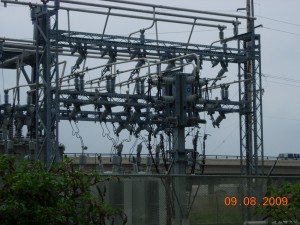
Consumers Energy substation at Colony Farm Orchard. Photo by Richard Brewer

Consumers Energy substation at Colony Farm Orchard. Photo by Richard Brewer

Just a quick update for historical purposes:  Mid-afternoon on Tuesday 5 January 2010, Governor Jennifer Granholm signed HB 5207.  She made no reported comment and she has made no known responses to the hundreds of letters, phone calls, emails, and Faxes opposing the bill she received over the past several months.  Governor Granholm has not said Boo.

The Kalamazoo Gazette reported promptly the governor’s failure to veto the bill.  Reporter Paula M. Davis’s first sentence was, “Western Michigan University now has no official barrier to expanding its business park to a nearby 55-acre green space known as Colony Farm Orchard.”

It’s an appropriately neutral statement.  The official barrier, in the form of a restrictive covenant placed on the land at the time it was given to WMU in 1977, has been removed.  The land now belongs to WMU to do with as it may.  One possibility, of course, is to retain it as open green space, not because the university has to, but because it’s the right thing to do.

One immediate response to the governor’s action was an increase in the number of alumni and former supporters calling for a boycott on donations and other types of support to WMU, the WMU Foundation, and other WMU-related causes.  One letter to President Dunn (which I received a copy of) said, “I feel that WMU’s recent actions in this matter reveal a profound lack of respect for the wishes of donors in general. Supporters of WMU are beginning to feel mistrustful about the intentions of the university in regard to the Kalamazoo community.”

One area of mistrust is the real long-term intentions of WMU as to the Asylum Lake Preserve.  Although WMU was party to a Declaration of Conservation Restrictions that is supposed to protect this land in a fashion similar to a conservation easement, the disregard for the covenant protecting the Colony Farm Orchard shown by WMU and the state has brought suspicions and fears of earlier years back to life.

My guess is that we have not yet seen the last go-round.

Probably the last review of Conservancy: The Land Trust Movement in America

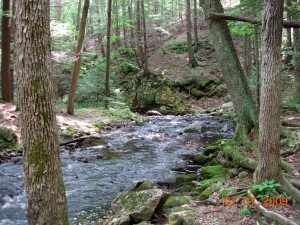
Stream at Rock House Reservation, West Brookfield MA, a preserve of The Trustees of Reservations, the first land trust.  Photo by Richard Brewer.

Swift River at Bear's Den Reservation, New Salem MA, a preserve of The Trustees of Reservations, the first land trust. Photo by Richard Brewer.

In the earlier version of my website, I had a page where I posted reviews of Conservancy: The Land Trust Movement In America, or links to them.  The last count was a dozen.  Posted here for the sake of completeness is the last one, as far as I know. It appeared in 2006, by which time I was not spending a lot of time on the old version of the website.

CONSERVANCY: The Land Trust Movement in America. By Richard Brewer. Lebanon, NH: University Press of New England. 2003

Reviewed by Donna Luckey, University of Kansas
Published in American Studies 2006,
47 (3-4): 244-245

[p. 244] Richard Brewer has given us a thorough review of land preservation and conservancy history in the United States. He provides a comprehensive treatment of land trusts, focused specifically on those trusts with the “intent to preserve land” as their stated mission. There are three main sections: the early chapters cover background for land preservation, the middle section serves as an excellent handbook for those involved with land trusts, and additional chapters provide case studies of major conservancies and local land trusts in this country.

Beginning with strong arguments for preserving biodiversity, Brewer provides species-specific examples, like the role of Running Buffalo Clover relative to ecological communities and ecosystem succession. He clarifies the differences between early advocacy groups and land preservation groups, explaining how that distinction has carried into the present. A key point is the growth of conservancies since 1980s, cited by Brewer as the true beginning of the land trust movement in America. He explains this well, illustrating the connections to environmental awareness, changes in the federal government’s policies, and other aspects of that era.

The middle section, chapters 3-8, is very useful for landowners, land trust staff, and board members. It addresses questions of land protection: why, who, which lands, how, and what is “land stewardship”? Brewer builds directly on the earlier material, grounded in his extensive background and experience as a biologist and land trust board member. It is here that he answers explicit questions, including how to distinguish forms of land protection. For example, there is a very good section (114ff.) clarifying the actual costs of protecting land, and how to estimate them. Brewer describes the complexities of Conservation Easements, currently very popular (as verified through statistics from the Land Trust Alliance [LTA] workshops, journal articles, etc.). He examines landowner benefits for those who protect land using Conservation Easements, while also raising the “non-economic” values that motivate landowners. He emphasizes ongoing stewardship as most vital; this is key among emerging issues of the conservancy movement today. Education of future generations of land-

[p. 245] owners with property protected by Conservation Easements is also raised as critical. These examples and detail, educating the public as well as current and potential land trust board members, is the gift of Brewer’s work. More images and graphics would nicely enhance this powerful text. On p. 11 Brewer describes the powerful impact four Wisconsin maps compiled by Curtis in 1956 had on him; his own readers would similarly benefit.

Additional acknowledgement of some early key players might be appropriate. These include Ralph Borsodi (father of “trustery” and the International Independence Institute) and Robert Swann. In 1972 the latter, with others, wrote The Community Land Trust – A Guide To A New Model For Land Tenure In America. The Community Land Trust (CLT) movement is indebted to these pioneers, and Brewer explains on p. 11 that CLTs focus on low-income housing. The common roots however are significant. The California State Coastal Conservancy (CCC) also provided timely and significant assistance to California land trusts forming during the critical years Brewer describes. The Humboldt North Coast Land Trust is but one example (cited by Brewer in the chapter on TPL, [222-223]) of a coastal land trust receiving CCC assistance, including financial, political, and organizational instruction.

The Lincoln Institute of Land Policy, referenced by Kingsbury Browne on p. 35 for funding his 1977 report “Case Studies in Land Preservation,” continues to contribute to this field. Jeff Pidot’s timely paper, “Reinventing Conservation Easements: A Critical Examination and Ideas for Reform,” is from the Lincoln Institute (2005). Like the CCC, the Lincoln Institute has many programs, yet each organization has played important roles for many land trusts throughout the country.

Overall, Brewer’s history is thorough and the cases detailed and well documented. He provides a good range of different types of preservation organizations and their structures, with lessons from both success and failure through many examples. This book serves the land trust movement well in each realm–as a history, as a handbook, and for general education. He is right on target with current issues in the final chapter: stewardship, public perceptions and education, and organizational relationships. Brewer gives us hope for the future of land preservation in the USA.

What Does WMU Really Want the Colony Farm Orchard For?

DSCN1951The Kalamazoo Gazette for Wednesday 30 December 2009 had a front-page article with the headline “Bill to allow WMU business park expansion is on governor’s desk.” In it we learned that “WMU leaders hope to expand the Business Technology and Research Park to the 55-acre Colony Farm Orchard property….”

But do they?  WMU has claimed that it wants and needs the Colony Farm Orchard for such expansion and has repeatedly implied that this is what it will do with the land.  Furthermore, its lobbyists and other spokesmen have sold House Bill 5207 to the legislature and the governor by claiming that it is a jobs bill.  Passing it, they say, will allow WMU to create jobs and fuel economic growth with an expanded BTR park.

The whole process has been a commentary on how WMU and Michigan–and perhaps other universities and states–have lost their way.  WMU could use the land for education, for research, for service–the three touchstones of a university’s role in our society–without any need for shenanigans in the legislature.  Instead it ignores these public uses and stakes its claim on job creation and feeding the local private economy.

The “This-park-grows-jobs” hot air has, in fact, been a successful ploy.  Some legislators may have believed the claims, and some that didn’t may have concluded there was no political risk to going with the flow.  Both houses of the legislature passed HB 5207 by large margins.  The bill is awaiting the governor’s attention.  We may soon learn Governor Granholm’s reaction, or we may not; it’s possible she may let it become law without signing it.

HB 5207, of course, has nothing to do with jobs or with a BTR park.  What it does is strip a legislatively imposed restriction from the Colony Farm Orchard, land bought with tax-payer dollars.  The 1977 conveyance from the state provides that “Western Michigan University may utilize the property solely for public park, recreation, or open space purposes, except that the legislature, by statute, may authorize Western Michigan University to utilize the property for some other public purpose.” HB 5207 written for WMU and introduced in the House by Representative Bob Jones (D-Kalamazoo) requires the state to buy the Colony Farm Orchard from WMU for $1, remove the restriction, and sell it back to WMU for $1.

As introduced, the bill included a new restriction that required WMU to use the land to expand the BTR park and provided that in the event of activity inconsistent with this restriction the state could take the land back.  But when the bill came out of Representative Jones’s committee, that language was gone.  The only restriction remaining in the bill sitting on the governor’s desk is that any arrowheads or other aboriginal antiquities that are found belong to the state.  In other words, if the bill becomes law, WMU can do anything it wants with the land.  It does not have to be used for a BTR park; it does not have to be put to public use.  It can be used for anything.
DSCN1947Based on WMU’s rhetoric, a restriction that the land be used to expand the BTR park  was quite logical.  Its quick disappearance is one line of evidence suggesting that WMU does not plan to use Orchard this way now, if it ever did.

WMU’s language about its plan for the Orchard has always been fuzzy. The Colony Farm Orchard and the glorious achievements of the BTR park have regularly been mentioned in the same breath, but in retrospect the absence of a firm connection is striking.  At no time have we heard WMU say, “When the restrictions are removed, we will expand the BTR park onto the Colony Farm Orchard”.  Here are a few quotes from WMU administrators:

Bob Miller, 24 February 2009, “The BTR has been a wonderful success, and we are looking at a possible expansion. No decisions have been made. The Orchard property… is an option. But at this point, it’s premature to even assign a timetable to it.”

Bob Miller, 26 February 2009, “There are no plans to develop that area [Colony Farm Orchard], but it is one of the options we are looking at…. I can tell you, should a decision be made to expand the Business, Technology and Research Park, we would come to you, to the entire community with our plans and share them. [But] we have none.”

John Dunn, 23 September 2009, “Our park is vibrant and full, and more than 1,300 jobs have been directly or indirectly created by its presence….We urge our lawmakers to vote for removal of the restrictions. Then, when the time is right in the coming months or years, we can move appropriately to expand our job-generating BTR Park.”

Why might WMU not want to expand the BTR park onto the Orchard land?  There are a number of possible reasons.  As many of us have pointed out, it has always been a poor choice.

  • For one thing, it’s too small. It might be big enough for three new tenants, but three lots are still vacant in the old BTR park and the temporary soccer fields could hold at least two more.
  • About a third of the Orchard site, the section where the fruit trees themselves are located, very likely has soil contaminated with lead and arsenic from the fruit-growing practices of the period from the 1880s through the early 1940s.  Development that involved excavating, grading, or other soil disturbance would probably require expensive remediation–hauling off several inches of top and subsoil to a toxic waste dump and bringing in clean replacement soil.
  • Michigan State University has a lease on the land allowing it to conduct experimental research on pest insects.  WMU is proposing to buy MSU out over a period of three years for up to $985,000.  Why WMU negotiated such an unfavorable deal is one of many puzzles in this process.  As far as I can tell no one in the WMU administration asked any of the professional entomologists or ecologists on the faculty to look into the experimental pest insects research.  For example, is there still an experimental component to whatever MSU is doing there?

The Colony Farm Orchard is deficient for BTR park expansion in many ways.  Several alternative sites are larger, definitely uncontaminated, not the subject of a prior lease, and a better fit otherwise.DSCN1948
WMU’s talk about the vibrant, wonderful performance of the BTR park whenever the subject of the Colony Farm Orchard came up now looks–and smells–like a red herring.  What, I wonder, does WMU really have in mind for this 53 acres, its old apple trees and grape arbors, its bur oaks, red foxes, wild turkeys, and bluebirds.

There are probably still a couple of days to get your recommendation for the Colony Farm Orchard to the governor. Phone calls would probably be best, email next.

Contact information for Governor Jennifer Granholm:

Phone: (517) 373-3400
Phone: (517) 335-7858 – Constituent Services
Fax: (517) 335-6863

PO Box 30013
Lansing, MI 48909

Here is a link to an email citizen opinion forum.

Here is a link to the governor’s standard email.