Button from the Facebook group
As we all know, HB 5207 put forth by Representative Bob Jones (D–Kalamazoo) is designed to strip the conservation/public use restrictions from the Colony Farm Orchard as a first step in turning the 54 acres into an Annex to Western Michigan University’s BTR Park. Here are the stated restrictions: “The conveyance shall provide that Western Michigan University may utilize the property solely for public park, recreation, or open space purposes, except that the legislature, by statute, may authorize Western Michigan University to utilize the property for some other public purpose.” The bill, introduced in mid-July with no public notice, made its way quickly to the Senate but there progress has slowed.
This delay has given conservationists and other opponents of the measure a chance to make their views known, and they have done so in large numbers. As of now, we cannot know what will happen. But we should talk about what ought to be done with the property as conservation land. I made a start on this subject earlier and concluded that the best role for the land was exactly what it’s doing now, but better.
In that post, I discussed some important ecological functions of the Colony Farm Orchard. I won’t repeat them in detail, but here’s a quick list. It’s worth taking note that all these would be diminished or lost altogether by development as a BTR installation.
Many are beneficial effects that the Orchard exerts on the Asylum Lake Preserve, such as
- Reducing noise from M-131
- Filtering noxious fumes from trucks and automobiles on M-131
- Reducing artificial lighting coming from M-131 and buildings across the highway to the west. Research on the dangerous effects that bright artificial lights have on insects, bats, amphibians in the breeding season, and other forms of wildlife is accumulating rapidly.
- By serving as a very near island of similar but not identical habitats, the Orchard adds species, lowers extinctions and enhances immigration, all of which lead to higher biodiversity and ecosystem stability at Asylum Lake.
Other positive conservation roles the Orchard plays, not necessarily involving the Asylum Lake Preserve directly, include
- Allowing for the presence and reproduction of shy animals, such as foxes and American woodcock, that are likely to be disturbed on the more heavily visited Asylum Lake Preserve.
- Serving as a migratory bird stopover site well-supplied with cover, water, and food supplies in both spring and fall.
- Preserving land within the historic Genesee tall-grass prairie and the adjacent bur oak opening. Perhaps few herbaceous species survive from those pre-settlement plant communities, but numerous bur oaks of various ages and sizes are present that are almost certainly descended from the oaks of the original savanna.
This is just a good start on a listing of the conservation values of the Orchard. There are, for example, the marvelous asparagus patches along the west edge. Not for nothing was Euell Gibbons’s first book named Stalking the Wild Asparagus. “When I am out along the hedgerows and waysides gathering wild asparagus,” he wrote, “I am twelve years old again and all the world is new and wonderful as the spring sun quickens the green things into life….”
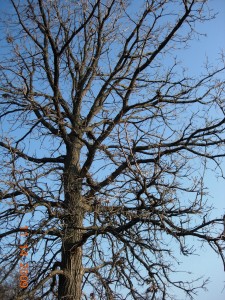
There are also the old trees–horse chestnut, tulip tree, maples–planted by the original farm family or by the staff or patients of the Colony Farm. Big and open grown but surrounded now by many trees of smaller diameters, these are probably what suggested the “Enchanted Forest” name to the Facebook Group. They ought to be kept as a way of conserving human history as well as natural history.
Then there is the carbon sequestration that has gone on and is going on in the accumulation of tree biomass, which acts to temper the greenhouse effect and slow global climate change. Turning this land into a BTR park extension would almost certainly mean cutting most of the trees and brush and releasing the stored carbon into the atmosphere as carbon dioxide either by burning or by the slow fire of decomposition.
It’s not possible yet to come up with a complete conservation design, but here are some things we might want to do when the Colony Farm Orchard is devoted to conservation.
1. Construct a self-guided loop trail going through the property’s major habitats with the trailhead on the east side of the property next to Drake Road.
2. Next to the trailhead, construct a small bicycle parking space. Too much space for automobile parking has already been subtracted from the Asylum Lake Preserve to allow more to be lost for auto parking here.
3. Provide for safe passage of pedestrians from somewhere south of the Asylum Lake parking lot at the top of the hill on Drake by means of pedestrian on-demand lights, or an overpass.
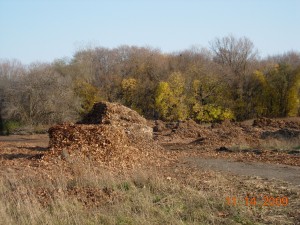
4. Stop the dumping of leaves and yard waste from Kalamazoo. It’s a public service of a sort, but on a parcel of only 54 acres it takes up space that ought to be available for natural revegetation or restoration. The area of thick leaf mulch can be seen in one of the fine low-level aerial photographs of the Colony Farm Orchard by JaySeaAre. Locate the metal pole barn (“Butler building”) on the west border (toward the highway); the heavy leaf mulch is the unvegetated area east of the Butler building and running south toward the electric substation and north toward the old orchard. Several years accumulation are involved, ringed with rank growths of barnyard weeds.
5. Erect a signboard facing M-131 that says something like this:
Asylum Lake Preserve of Western Michigan University
A sanctuary of 320 acres protected for all time
that by education, research, and as green and open space
benefits the public and the Earth
Before describing what the trail could be like, it’s worth considering why we need a trail at all. People who are highly enough motivated have always made their way onto the Orchard for bird-watching, asparagus hunting, photography, and contemplation. And no trail is needed for the Orchard to continue its services to the Asylum Lake Preserve. But there are good reasons for the trail: One, it will make it much handier to visit the site, especially for education–classes, but also groups interested in natural history, and any strolling autodidact.
Two, if the Orchard is left as is, there will be those who say, as some connected with WMU have said, that the land is not utilized. Of course, the charge was and is bogus. But the trail is one way to demonstrate utilization. It will show most people that the land is utilized, though perhaps not that segment of humanity for whom the only meaningful way a piece of property can be utilized is to generate income.
What should the trail be like? I’d say most of it should be narrow, just wide enough for one person to walk comfortably, and unimproved. No dogs, I’d say. It’s nice that people can walk their pets on the Asylum Lake property, but the Orchard ought to continue to be a dog-free refuge, a place for the woodcocks and turkeys and other ground nesters.
There would be plenty to see along the trail, including many of the features already mentioned. Any trip would find dozens of things to look at and discourse on, as the changing seasons brought forth something new every day.
The trail should loop through the south part of the WMU Foundation property. In fact, I’d say that the south half of the Foundation land ought to be reunited with the Enchanted Forest. The eight acres extending up to Stadium Drive were regrettably severed from the Orchard property in 1957 and sold into commerce. The Foundation did Kalamazoo a service by acquiring it in 2007.
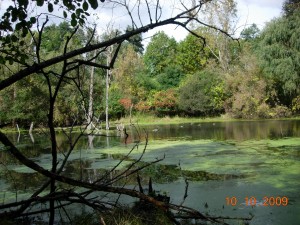
Pond with Mallards on WMU Foundation land just north of Colony Farm Orchard. Photo by R. Brewer
Having the trail run through the south part of what is now Foundation property would include a small pond and the ducks and aquatic life that could be seen there and also an area of great hydrological interest as the main source of ground water flow into Asylum Lake.
These are just some ideas of mine. I haven’t discussed them in detail with anybody. No charette was held. Nobody paid me a consulting fee; my work was all pro bono publico. Publico has been given short shrift in WMU’s proposals for the Orchard, so I’m glad to bring a little of it back.
Will the Colony Farm Orchard be allowed to fulfill these conservation aims? That depends on the Michigan Senate, or perhaps Governor Granholm. But, of course, it depends most of all on Western Michigan University, which could at any time, decide to let the Orchard live up to the purposes for which it was conveyed from state to university in 1977. That WMU has not already asked the Michigan legislature to withdraw the section of HB 5207 dealing with the Colony Farm Orchard reveals an anti-conservation, anti-environment, anti-sustainability mindset that may foretell a troubled future.