Monthly Archives: October 2009

Save the Enchanted Forest (aka Colony Farm Orchard)!

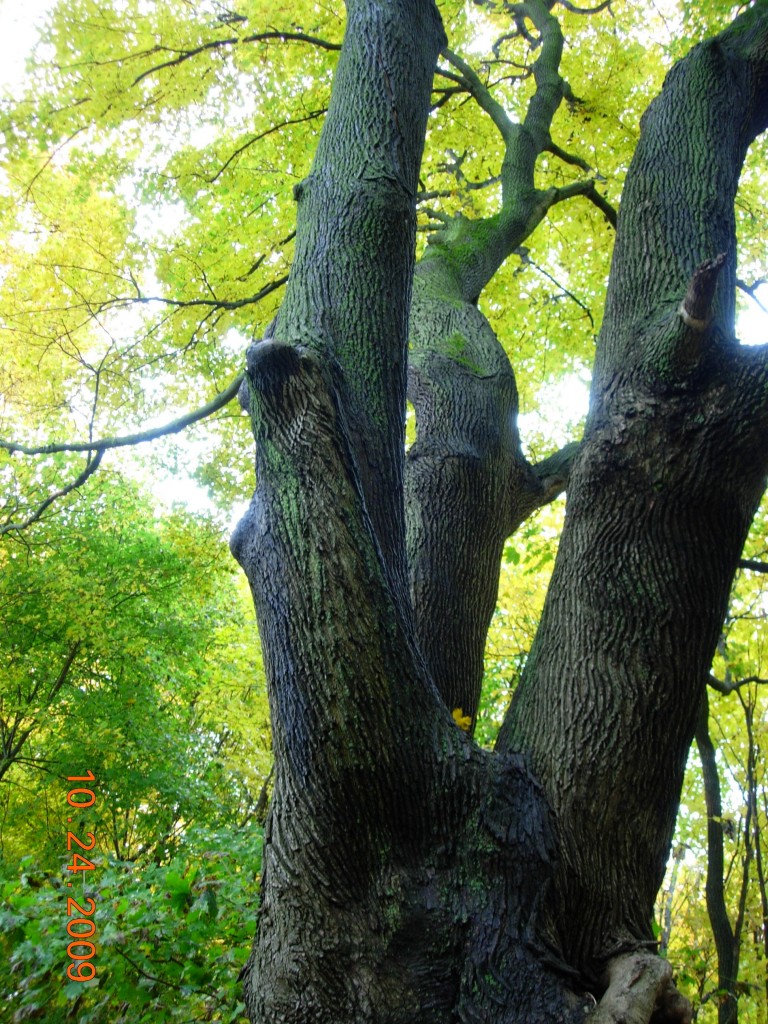
DSCN3142About a week ago, a group of students opposing the demolition of Western Michigan University’s Enchanted Forest, invited me to one of their meetings. The Enchanted Forest is what they call the land that is sometimes known as the Colony Farm Orchard. Enchanted Forest is a much better name.
This was a Thursday night and they were planning a letter writing session for the following evening.  I talked for a little while about past and current threats to the Enchanted Forest.  Andy Weissenborn and a dark-haired young woman whose name I didn’t get asked a few questions that I tried to answer. I gave them my take on how best to get in touch with members of the Michigan Senate, where the bill stripping the restriction that the land be kept as open space for public use was then, and still resides today (30 October).

The student group is on facebook.  Here are the first few lines of the group’s description:

Western Michigan University is moving ahead with a plan to expand the Business Technology and Research Park. In order to do this, they are going to flatten the woods at the northwest corner of the Drake and Parkview intersection, the “Enchanted Forest.”  Don’t get us wrong, we’re not against development in general. And we’re not against new business and new jobs.

The facebook group is open and the content is public.

The students have evidently put on a very effective campaign to reach members of the Senate.  Check out Chelsea Thorpe’s comments for 29 October on the group’s Wall.  Among other things, she says, “Call, write, my babies! Let’s save the dadgum Enchanted Forest!” and includes the phone number for the person to call in Lansing about postponing the vote (Senate majority leader Michael Bishop at 517 373 2417.)

I’ve heard that other actions to save the Enchanted Forest are being planned or contemplated.

In my opinion this effort is the greenest and most biospherically useful thing that’s happened at WMU at least since Dok Stevens left and maybe since Huey Johnson graduated.

Save the dadgum Enchanted Forest!

The Colony Farm Orchard is Not Trade Land

Horse chestnut tree at Colony Farm Orchard.  Photo copyright October 2009 by Richard Brewer.

Horse chestnut tree at Colony Farm Orchard. Photo copyright October 2009 by Richard Brewer.

I’ve always wondered if there was one fundamental difference between conservationists and those other people whose disposition is exactly opposite–the  exploiters, polluters, clear-cutters, mountaintop blasters, and all the other ill-users and abusers of the land and waters. In recent experiences with the case of the Colony Farm Orchard, I think I have an inkling of what the fundamental difference might be.

Several years ago The Nature Conservancy coined the term “trade land” to refer to real estate given to the organization merely as an asset, like a used car or shares of stock, rather than as land meant for preservation. In earlier days, people had sometimes been unhappy, even irate, when they heard of TNC selling land, thinking that sanctuary land was being sold. The term was invented to refer to lands with minor conservation value that are donated mainly for the money that TNC can raise by selling them.

The 54-acre Colony Farm Orchard (henceforth, just Orchard) in Oshtemo Township, Michigan, has certain features that make it desirable for conservation. I’ve listed these in more detail in earlier posts (such as this one), but they include a variety of habitats, historical interest from being located within the tall-grass Genesee Prairie and bur oak opening, and prime habitat as a migratory bird stopover site.  Perhaps more important is that the Orchard contributes to increased biodiversity and stability of the 270-acre Asylum Lake Preserve which is adjacent to the east, across Drake Road.  The Orchard serves as a very near island of similar but not identical habitat.

The State of Michigan gave the Orchard to Western Michigan University in 1977 for the purposes stated in the original legislative conveyance: “Western Michigan University may utilize the property solely for public park, recreation, or open space purposes, except that the legislature, by statute, may authorize Western Michigan University to utilize the property for some other public purpose.”

The intent is perfectly clear; this is land conveyed as dedicated open space for public use. The Orchard is not trade land.

Nevertheless, in the 1990s, WMU sought to develop the Orchard as part of a proposed BTR (Business Technology Research) Park.  A long battle ensued between WMU, elements of Kalamazoo City government, and certain corporations on one side and various environmental and neighborhood groups plus a high percentage of the citizenry on the other.  The first major skirmish was an attempt by WMU to get around the quoted restriction.  WMU persuaded a local Michigan House member, Dale Shugars, to introduce legislation changing the permitted uses to “1. For a public park, recreation area, or open space area.  2. For a business, technology and research park…” The bill with the altered language passed the House, but a Senate committee concluded that a BTR park was not a public purpose,  The Senate did not act on the bill, and in 1993 it died. The Orchard was saved.

Many things happened between 1993 and now.  One was a compromise of sorts, by which land south of Parkview Avenue, which had come from the state to WMU with no restrictions, was opened to the development of a BTR park. Such a development was begun in 2001. The Asylum Lake parcel north of Parkview and east of Drake that had come to WMU in 1975 with exactly the same restrictions as the Orchard was designated as a Preserve.  It was further protected in 2004 by a Declaration of Restrictions, meant to serve the same function as a conservation easement.

The Colony Farm Orchard is at the upper left in this diagrammatic map which appears on the Asylum Lake website

The Colony Farm Orchard is at the upper left in this diagrammatic map which appears on the Asylum Lake website

During the years between 1993 and 2004, agreement had been reached on a variety of topics. The conservationist participants in the discussions believed that the Orchard, north of Parkview and with the same legislative restrictions as the Asylum Lake property was a part of the Preserve.  The WMU participants, however, rebuffed all attempts at explicit inclusion of the Orchard in the Declaration of Restrictions.  Probably this should have been a signal that WMU was not giving up its plan to violate the restrictions on the Orchard, but the participants were comforted by the fact that the land was still protected by the original restriction. Perhaps they were also tired after the years-long debates.

Faint signals of a renewed attempt on the Orchard could have been noticed in late February 2009.  WMU Vice-President Robert Miller emerged from WMU’s five-year Orchard dormancy to tell one of the Asylum Lake neighborhood groups: “There are no plans to develop that area, but it is one of the options we are looking at. I can tell you, should a decision be made to expand the Business, Technology, and Research Park, we would come to you, to the entire community with our plans and share them. [But] we have none.”

By 2 July, the signal was much stronger.  The WMU Board of Trustees at its July meeting empowered the admistration to spend up to $985,000 to buy out a long-standing Michigan State University lease to conduct pest insect research on the Orchard.  Greg Rosine, another WMU Vice President, made it all explicit; he mentioned the deed restrictions and said that WMU was “seeking to get those restrictions changed.” Local Representative Robert Jones introduced House Bill 5207 to strip the restrictions on 16 July, though the first local public notice was not until 1 August.

Local adverse reactions were evident as early as 14 July at a meeting of the Oshtemo Township Board. Numerous letters and phone calls followed in later days and weeks, to the Kalamazoo Gazette, WMU administrators and board members, and local members of the legislature.  Much of this is related in earlier posts at this website.  As of the day I write, 28 October 2009, the bill has passed the House and been approved by the Senate Appropriations Committee.  Tardy and prolonged debate on the state budget, typical of the Michigan legislature, has delayed immediate action in the Senate.

Proponents of removing the restrictions and making the Orchard an annex to the current BTR park have said little publicly and have been unwilling to engage in any public forum or debate.  Apparently, their arguments are that the BTR is full, that it created more than 1,300 jobs “directly or indirectly” and an expansion would create many more, and that it is a logical site for expansion because it is already owned by WMU, is adjacent to the current park, and is not utilized.

Some of the claims are questionable and the rest are wrong.  The BTR park isn’t full.  Were the jobs “created” or were they jobs that, in the absence of the BTR park, would still have lodged somewhere in the Kalamazoo area? Considering the current job market, how soon will a BTR Park annex actually be needed?  Plenty of other sites exist for expansion, if expansion should ever be necessary. Included are other unrestricted properties owned by WMU as well as remediated brownfield sites in Kalamazoo that are going begging.  Although WMU’s early, obfuscatory statements in February mentioned that expansion to the CFO was “one option,” evidence is lacking than any other site was considered.

In fact, the main argument in favor of the Orchard is money. The Orchard is land bought with taxpayer dollars and given to WMU by the state for public use as open space.  Expansion of the BTR park would consist of dividing the parcel into a few lots and selling them for commercial use at market value.  Estimates for total income from the sales start at around $3 million.  With a cost basis of zero, WMU could reap a handsome profit.

In a rational accounting, the justification for converting this public open space to a BTR park annex fails.  To me and a good many others, there is little need even to do the accounting.  Here is land that in the transfer from state to university was set aside for the public good in language as plain as can be written.

I believe that here we are coming close to the fundamental distinction between conservationists and exploiters.  The difference is the unwillingness or perhaps the constitutional inability of the exploiters to understand and honor a perfectly explicit covenant.  They see it as nothing more than an obstacle to making money from the land, to be gotten around or over.  To them, conserved land is not utilized; conserved land does not perform.

To the exploiters, all land is trade land.

Saving the Colony Farm Orchard: You don’t have to be an environmentalist

This is a response to an unsigned editorial published Monday 5 October 2009 in the Western Herald concerning Western Michigan University’s designs on the Colony Farm Orchard.  Since it was unsigned, it’s presumably the official position of the Herald Editorial Board.  My response was published in the Herald on Monday 12 October.  The version here is slightly modified from the published version.

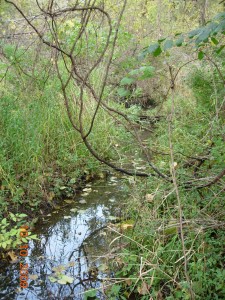
A small stream in the springy area at the north end of the Colony Farm Orchard.  Photo by Richard Brewer.

A small stream in the springy area at the north end of the Colony Farm Orchard. Photo by Richard Brewer.

A Herald editorial endorsed WMU’s attempt to turn the protected Colony Farm Orchard into an annex of the BTR park.  After a kind of cost/benefit analysis the Herald concluded that the university would make a bunch of money.  Just four quick points:

1. Since WMU paid nothing for the land (bought by the state with taxpayer money), WMU ought to be able to sell it at a profit.  Who couldn’t? The BTR park has done well–or so we’re told. WMU never provides cash flow figures.

But the BTR park opened near the beginning of one of the biggest booms, or bubbles, in U.S. history. The Dow Jones Industrial Average went from below 10,000 to over 14,000 between 2001 and 2007.  Then the economy crashed and burned. By early 2009 the Dow dropped below 7000; the wealth that people thought had been created disappeared.  Today the Dow is struggling to get back to where it was in 2001.

The current BTR Park has three unsold lots and at least two vacancies, plus the soccer field which remains to be developed.  It may be years before new lots in the Annex are needed.  Or they may never be needed.

2. People like me who want to save the Orchard do not object to WMU making money.  Most public universities, including WMU, have been so starved by state government that to stay in operation they need to beg, borrow, and accept grants and contracts from large corporations that do not have the public good uppermost in their minds.  But there are lines that should not be crossed.  WMU crossed the line with their Colony Farm Orchard plans.

3. The idea that WMU deserves credit for protecting the Asylum Lake Preserve is fantasy.  Its protected status is the outcome of a long, intense battle all through the 1990s between the WMU administration on one side and many people on the other.  Among the WMU opponents were the Asylum Lake Preservation Association; neighborhood groups; an active, vocal group of WMU students; assorted conservationists and environmentalists; and, toward the end, the Michigan Senate following the lead of Senator Jack Welborn.

As late as 1998 when the chance of a business park on the Asylum Lake property and the Orchard was long dead, the WMU administration was still trying to turn the Asylum Lake property into a golf course! WMU lost. This land became the Asylum Lake Preserve.

4. The editorial mentions Aldo Leopold’s land ethic. Adherents to the land ethic will be opposed to WMU’s plan, but you don’t have to be an environmentalist to know it’s not right.  That follows from an older, easily understood ethical principle, the idea that we keep our promises. This is the first reason why WMU should not try to overturn the dedication of the Orchard as open space. A conservation reason is not far behind: How can conservation land ever be secure if the promises of protection by land holders such as the government and the university mean nothing?

Will those who come after us at WMU say of the current leadership, They kept the faith? Or will they say, They betrayed a trust?

Private Options: The Leading Edge in Conservation Today

This review was published in 2005 as the second entry in my Land Trust Reading List on the earlier version of this website.  Slightly revised and updated, it’s republished here on the occasion of the 2009 Land Trust Alliance Rally.

privateoptions5

Private Options: Tools and Concepts for Land Conservation. Barbara Rusmore, Alexandra Swaney, and Allan D. Spader, Editors. 1982.  Island Press.

This proceedings volume brought together a great fund of information about land trusts at an important time in the development of the movement. Nearly thirty years later, the book is still useful to anyone trying to learn about land trust operations. Other than some specifics of tax law and regulations, little of the material is outmoded.

The approximately 75 papers came from the first two conferences aiming to take a national view of  private land conservation by local organizations.  Both were held around this time of year 28 years ago, in the fall of 1981.  The first, the National Consultation on Local Land Conservation, was held in Cambridge MA October 14-16 under the auspices of the Lincoln Institute of Land Policy. The second a month later, November 13-15, was Private Options for Land Preservation, A Conference for Practitioners.  It was held in San Francisco, though under the sponsorship of the Montana Land Reliance.

The Lincoln Institute, a land use policy group, was relatively new, founded in 1974. The Montana Land Reliance, a local land trust, was still newer, formed in 1976 and awarded non-profit status in 1978.

Land trusts formed since the later 1980s have mostly been named “land trusts” or “land conservancies,” but those formed in the hundred years between 1891 (the Trustees of Reservations) and the early 1980s used a variety of names, sometimes “trusts” or “conservancies” with various modifiers, but also many “associations,” “societies,” or “foundations.” As far as I know, the Montana organization is still the only “reliance.” Perhaps it was called a “reliance” from the rarely used definition of “one relied on.” There may be more to it than that or, possibly, less.

The book combines material from the two conferences; that from the National Consultation amounts to about 60 percent to the Private Option’s 40 percent. A separate proceedings for the National Consultation had been quickly assembled and published by the Land Trust Exchange (later, Land Trust Alliance), the national umbrella organization to which the conference gave rise. The National Consultation material included in this book is virtually identical to the separately published proceedings. Proceedings from the Private Options conference were advertised but evidently never produced, probably being incorporated directly into the joint volume.

Two conflicting emotions dominated the conferences. One was gloom over the threat to conservation and environmental protection that came from the new (January 1981) administration in Washington, that is, from Ronald Reagan and George H. W. Bush and their appointees. “Somewhere between Teddy Roosevelt and James Watt, the Industrial Revolution won out over the purple mountains’ majesty,” wrote Maggie Hurchalla, a representative of a Florida land trust to the National Consultation. “Land trusts are largely an answer to government failure. As a result, they are an accusation.”

But there was also a feeling of excitement at the great potential of private land conservation. Cecil Andrus, governor of Idaho and Secretary of the Interior under Jimmy Carter, gave the keynote address at the Private Options conference. He called the blossoming land trust movement the “leading edge” and the “third wave” of conservation in the U.S. The first wave was the rise of government protection of land, wildlife, and forests–the National Parks, National Forests, game protective laws, and conservation advocacy groups. The second was the popular environmental movement of the late 1950s, 1960s, and early 1970s with its accompanying federal and state regulatory legislation. “I call you the third wave,” Andrus said to the gathering.

In a section of comments from participants of the National Consultation, Allan D. Spader, the organizer of the conference, said, “The relatively spontaneous accomplishments and growth of the local land trust movement [are] unique in a world where success is measured in terms of media hype…or a government program grant.” And Robert Augspurger of the Peninsula Open Space Trust (CA), wrote of the conference itself, “[O]ne might compare [it] to an old-fashioned revival meeting. Here we had a group of ‘circuit-riders’ from all over the country, coming together to refresh, reinspire and reeducate each other. The results were indeed electric.”

Authors include a good many persons still active in the land trust movement–after all, it was less than 30 years ago. Among these are Mark Ackelson, Joan Vilms, Martin Zeller, Jean Hocker, and William Hutton. Some figures important in the exponential growth phase of land trusts are gone or less engaged now. Among these are Kingsbury Browne, Jr., Russell L. Brenneman, Gordon Abbott, Jr., and Benjamin R. Emory. Several more who contributed to the discussions were active for a time but are no longer connected with land trusts or, at least, not in any very visible way. Where, for example, is Maggie Hurchalla, author of the provocative quote a couple of paragraphs back?

[Added 14 August 2009.  I now know where Maggie Hurchalla is.  I was put on the trail by a column in Parade magazine.  (I make it a point to spend at least 30 seconds every Sunday reading Parade.)  Her name came up in an answer to a question concerning former Attorney General Janet Reno.

I must have failed to google Maggie when I wrote the original review, because over five thousand entries came up when I tried the other day.  In addition to being Janet Reno’s younger sister, she has been involved in environmental battles throughout her life.  Among her causes have been growth management in Florida and wetlands protection and restoration, including the Everglades.  She served as a Martin County commissioner for 20 years (1974-94), was chosen Florida Audubon’s Environmentalist of the year in 1981 and was a National Wetlands award recipient in 2003.  As far as I can tell from material on the web, Hurchalla has little if any recent connection with the land trust movement.  But she has continued to fight the good fight.]

Most topics of importance to land trusts are at least mentioned in the volume. Among other subjects, we read about marketing, preservation of agricultural and historic lands, community land trusts, negotiation skills, tax policy and income tax incentives, conservation easements (including some early comments on possible problems), partial development, cooperation with government (pros and cons), some summary material from the first real census of land trusts, a bit of history, some regional perspectives, organizational development, and ideas about forming a national umbrella organization.

Although there is material on fee acquisition and stewardship of natural lands, an emphasis on conservation easements and agricultural lands is evident. This emphasis was unrepresentative of what the majority of the more than 400 land trusts in existence were actually doing as of 1981. It was, however, prophetic of the shifts in emphasis that characterized much of the 1980s and 1990s and prevail today.

Is this the Last Go Round for the Colony Farm Orchard?

asylumWednesday afternoon, 30 September 2009, the Appropriations Committee of the Michigan Senate approved the bill that would eliminate the conservation restrictions contained in the original conveyance of the state-owned land called the Colony Farm Orchard to Western Michigan University.  That language is “Western Michigan University may utilize the property solely for public park, recreation, or open space purposes, except that the legislature, by statute, may authorize Western Michigan University to utilize the property for some other public purpose.” The bill goes to the full senate, where it is being fast tracked to be taken up at its next session, Tuesday 6 October.

Removing the public purpose restriction will be necessary if WMU is to do what it claims is its goal–to expand its BTR (business, technology, research) park to the Colony Farm Orchard

Within minutes of the vote, WMU’s Senior Vice President for Advancement and Legislative Affairs Gregory Rosine called from Lansing to let the Kalamazoo Gazette know the news.

The story appeared in the Thursday paper, to the consternation of conservationists who have been working to retain the restrictions keeping the land for public purposes.  “Outraged” probably best characterizes the reactions of people I’m in contact with.  This was not because there had been strong expectations that the bill would be defeated.  Since the Appropriations Committee reflects the Senate composition, it contains eleven Republicans and seven Democrats.  Many of the arguments against the WMU action are conservation-based, so few Republicans were expected to oppose the bill.

The hope was that the local senator, Tom George, though a Republican, would be swayed by conservation arguments contained in the many letters sent to him and to the Gazette.  If he opposed the bill,  his colleagues might follow his lead because of his position as the senator from the affected district.

No, the reason for the outrage was that local conservationists expected to be able to attend the Appropriations Committee hearing and make their case for retaining the Orchard, perhaps along with other environmental groups and others who understood the seriousness of the issue.  None was able to attend the hearing because the bill was added to the Wednesday agenda without advance notification and passed within the same meeting.  The lack of notification extended to the Asylum Lake Preservation Association (ALPA) vice president who had signed up for automatic notification of the bill being placed on the committee agenda.  In fact, at 4:55 AM Friday 2 October, the day after the bill had been passed by the Committee, the message from the legislative website update@legislature.mi.gov said of HB 5207, “Last action: 9/21/2009 REFERRED TO COMMITTEE ON APPROPRIATIONS”[caps in original]

One might think that Senator George,  having noted the letters from his constituents, might think, “Hey, I bet all these people interested in this Colony Farm Orchard might like me to shoot them an email that it’s now on the agenda.”  If he thought that, he didn’t act on the thought.

ALPA, and everyone else, were caught flat-footed. Rumors that the meeting was occurring leaked out on Wednesday afternoon, but few organizations would be able to get to Lansing with persuasive testimony on the spur of the moment, and none did.  When I heard such a rumor, I searched every relevant legislative website and found no mention of HB 5207 being taken up by the Appropriations Committee.  I checked again the following morning–again,the day after the committee had approved the bill–and found no mention even of a changed agenda, let alone passage.

I have heard of other cases in the Michigan legislature of schedules being set so as to put opponents at a disadvantage.  Opponents usually are the other party, but often enough the sides are more complicated; that was the case in the Wednesday afternoon debacle.  The quick-snap in football is an acceptable tactic. In government, such goings-on violate American principles of fairness at the most fundamental level.

Businesses, local governments, and many state agencies have strict requirements to provide public notice for virtually any action in which the public or other parties might have an interest.  Society functions better as a result.  But in the Michigan legislature, there seem to be no penalties–only rewards–for keeping opponents and the public in the dark.

If Senator George read the letters sent to him, he was not swayed.  The Gazette article reporting the committee action quoted him as saying that “job creation” was the reason he voted for the bill.  He also said the BTR park is “one of the few examples of successful job growth in the city of Kalamazoo and in the state of Michigan, for that matter.”

Few Republicans will vote against job creation no matter what negatives may be attached or how bogus the claim. Few Democrats either, these days.  It’s possible that advocates for retaining the Colony Farm Orchard as open space should analyze the BTR jobs claims and other self-congratulatory marketing points. For example, just how many jobs is it that the WMU business park has created?

President John Dunn in his Gazette Viewpoint used a figure of more than 1300, but of these, according to other marketing pieces, 682, a majority, were “indirect salary creation.”  I’m not sure what this means, but I don’t think it’s people working shifts at the BTR park.  The larger question is, Has the BTR park created any jobs at all?  How many of these more than 1300 jobs were already around the area or were jobs that, had the WMU BTR park not been available, would have ended up elsewhere in the county–possibly at a facility set up by private enterprise.

The facts are difficult to get; the overriding fact is that the whole process WMU has followed in pursuing the stripping of the Colony Farm Orchard’s restrictions has been almost fact free. The closest thing to a analysis of the BTR park I’m aware of is an online comment (23 September 2009) of Dunn’s Viewpoint by someone signing himself evadrepus.  It’s a good start and deserves wider attention.

The unwillingness to provide facts is part of the general opacity of the whole process. When the question of pros and cons of the Colony Farm Orchard relative to various other obvious options comes up, WMU says…nothing. I have concluded that nothing means, “We will develop the Orchard, because you can’t stop us.”  A further translation is that “because you can’t stop us” means “the legislature will let us.”

I had almost reached this conclusion about a month ago.  The leaders in and around WMU had concluded that the Colony Farm Orchard was a slam dunk.  The economy/jobs argument was compelling, nobody cared about this insignificant sliver of land, it wasn’t being “utilized.”  But I still thought that something besides a simple case of hubris must be involved to account for the resoluteness with which the Colony Farm Orchard was being pursued.

The reason I now understand is an obvious one.  Money.  The land, bought a good many years ago by the state with tax-payer dollars, came to WMU free.  But unfortunately it came with a public use restriction.  By getting rid of that restriction (which was not a condition of the University Farm property that became the current BTR park), WMU can turn the Orchard into a few lots, perhaps 3-5, and sell them for a total of perhaps $3-$5 million.  This is a nice sum, and it’s pure profit.

The same answer explains one of the companion bills that Representative Bob Jones introduced, the one having to do with the former TB sanitarium.  Because my main interest in the WMU’s actions has been the protection of conserved land, I haven’t bothered to write about the sanitarium bill. I’ll wait to take it up another time, but it’s an even more clever legal maneuver.

It’s not impossible that the full Senate will reject the lifting of restrictions next Tuesday, as the full senate in 1993 was poised to do.

It’s not impossible that Governor Jennifer Granholm will veto the bill if it reaches her.

If neither of those things happen, then barring litigation, it seems likely that the open space/public use restrictions will disappear.  They would have lasted, not the perpetuity that conservationists hope that conservation lands will endure, but about 32 years.  This is figuring from the fall of 1977 when the Welborn brothers of Kalamazoo, one a senator, one a representative, added the Orchard to the adjacent Asylum Lake property (conveyed with similar restrictions in 1975) to give WMU the care of 329 acres of dedicated open space.

So, would this be the last go round for the Colony Farm Orchard?

Maybe not.

The loss of the legal restrictions would be a serious loss, making destruction of the Orchard much simpler in the future.  But even so, the conservationists and environmentalists of the state may stay in the game.  Even if they lose this go round, they may not yet be willing to let their deal go down.