Monthly Archives: September 2009

Colony Farm Orchard: New documentary film and a response to John Dunn Viewpoint

Matt Clysdale, from his website

Matt Clysdale, from his website

Matt Clysdale, a local film-maker (Animals Among Us), will be screening the first part of a two or more part film about Western Michigan University’s planned conversion of the Colony Farm Orchard open space to Business Park annex.  Here is his announcement.

Greetings everyone,

Please join me this Tuesday at 9 pm on Channel 19 for the
premiere broadcast of  “The Colony Farm Orchard – Part 1:
Here We Go Again”
, a video essay I recently produced on a
controversial, 54 acre piece of property adjacent to Asylum Lake.

The video is the first part in a series examining major issues
surrounding Western Michigan University’s plans to expand
the Business, Technology and Research Park onto the Orchard.

Part 1 explores the tumultuous history of the Orchard, previous
attempts to develop the property, and an earlier attempt to remove the restrictions on the property. Interviews with representatives from WMU, the Asylum Lake Preservation Association, and the Oakland Drive/Winchell Neighborhood Association, as well as former State Senator Jack Welborn and current State Representative Robert Jones, shed light on the inner workings behind this controversial, and necessary, community debate.

Matt Clysdale
HorsePower Pictures


Response to John Dunn Viewpoint

Richard Brewer

After a long silence, President John Dunn of Western Michigan University provided some public commentary on the Colony Farm Orchard by way of a Kalamazoo Gazette Viewpoint on Wednesday 23 September 2009. Following is a response I submitted Sunday to the Gazette.  I tried to keep it close to the 500-word Viewpoint limit the Gazette requests, so there was no space to deal with several other questionable statements.  I will try to address these later.

By mid-July, people were writing letters to the Gazette warning about WMU’s attempt to strip deed restrictions from the Colony Farm Orchard. The restrictions would have to be killed for WMU to expand its BTR park operations onto the Orchard.  The restrictions say WMU “may utilize the property solely for public park, recreation, or open space purposes, except that the legislature, by statute, may authorize Western Michigan University to utilize the property for some other public purpose.”  Last week, Western Michigan University President Dunn wrote a Viewpoint about the Orchard.

It is well that President Dunn has finally spoken up.  Until now the only WMU statements came from subordinates.

The version of Asylum Lake history given by President Dunn will seem strangely light-hearted and his representation of WMU’s role improbably altruistic to anyone who kept track of the bitter controversies of the 1990s-early 2000s.  These came out of an earlier attempt by WMU to turn the Orchard, the University Farm, and part of the Asylum Lake property into a business park.

But then President Dunn was not here during that time; he took office in July 2007.  His knowledge comes from staff, associates, and the WMU Board. I fear they have not given him a full picture of the long  battle–or the dedication it created in those who still fight to protect this special place.

President Dunn states that the Orchard is a logical choice for development because WMU already owns it.  What he neglects to say is that by the restriction, WMU holds it as a public trust–to keep for all of us as open space.

Among several misleading statements, President Dunn claims that the development would be beneficial because it would provide space for retention ponds that would improve water quality in Asylum Lake.  This is a red herring.  There are other places for such ponds, including the old trailer park at the north end of the Orchard.  The WMU Foundation owns this property, and it is unrestricted.  Work on the retention ponds could begin tomorrow.

President Dunn commends the legislators who wrote the original conveyance of the Orchard for recognizing that “community needs could change and included a mechanism to make such needed changes.” Exactly! We have already seen the language: “the legislature, by statute, may authorize Western Michigan University to utilize the property for some other public purpose.” It is just this language that Representative Robert Jones’s bill would remove.

The reason for the Jones-WMU bill is that all of this played out once before, in 1993.  The House passed altered language that would have allowed the Colony Farm Orchard to be used as a research and business park.  When the bill reached the Senate, careful debate led the Senate to conclude that this was not a public use.  They refused to act on the bill, and the door slammed shut on that first misguided effort to turn this property into a business park.

But now a new bill is back, in the Senate Appropriations Committee. If the Senate of 2009 is less wise than the Senate of 1993, the bill may pass and the Colony Farm Orchard will be lost.  Even worse, the legislature will have gone on record that conservation restrictions for the public good are meaningless, to be wiped out whenever they are inconvenient for any group with a powerful constituency.  I emailed Senator Tom George asking him not to allow this. Other citizens unhappy with WMU’s attempt to sell this land bought with taxpayer money to private interests might wish to contact their own senators.

Colony Farm Orchard: The Ball Is In the Senate’s Court and Tom George Has the Racquet

image-1On Thursday 17 September 2009, in the Michigan House of Representatives, Robert Jones’s House Bill 5207 was read a second time, placed on third reading, placed on immediate passage, read a third time, passed and given immediate effect (Yeas 105 Nays 2), title amended, and transmitted to the Senate.  It all happened fast, though perhaps not as fast as its supporters in the Western Michigan University administration and  board have been hoping. Its passage by the House was recorded in the Kalamazoo Gazette.
In the Senate on Monday 21 September, the bill was assigned to the Appropriations Committee.  This committee consists of Senators Jelinek (C), Pappageorge (VC), Hardiman, Kahn, Cropsey, Garcia, George, Jansen, Brown, McManus, Stamas, Switalski (MVC), Anderson, Barcia, Brater, Cherry, Clark-Coleman, and Scott.  Of these, the most important for the future of the Colony Farm Orchard is Senator Tom George.

Everyone who believes that the Colony Farm Orchard should remain as dedicated open space might want to contact Senator George and ask him to make it so. His email address is sentgeorge@senate.michigan.gov

Following is a letter I sent to Senator George last night.

Dear Senator George–

What happens to the Colony Farm Orchard is now in your hands. Since the land is in your district, colleagues in the Senate will follow your lead. If the Senate votes not to remove the restriction placed on it when it was conveyed to WMU in 1977, the land will stay open space as was intended.

Removing the restriction (Western Michigan University may utilize the property solely for public park, recreation, or open space purposes, except that the legislature, by statute, may authorize Western Michigan University to utilize the property for some other public purpose) would be needed to convert Colony Farm Orchard (henceforth, the CFO) from dedicated open space into a new section of the so-called BTR Park.

The situation is an almost exact rerun of the attempt by WMU in 1990 to convert the CFO into phase 1 of a research and business park.  The Asylum Lake Preservation Association was founded soon afterwards, and a lengthy battle between WMU and the majority of the citizens of the region began.  The conflict came to a head in spring 1993 when the House passed a bill adding “or a business, technology, and research park” to the list of allowed uses for the CFO.

The bill went to the Senate Committee on State Affairs in April 1993. Prolonged, caustic discussion showed that the Committee understood what the intent of the legislature had been in the original conveyance and also showed that the members did not consider the BTR park a public purpose. On April 22, 1993, the Committee adjourned without action, but it was clear that, if a vote were to be taken, the new language would be rejected.  President Diether Haenicke realized that the battle was over and pulled the plug on the whole development proposal on May 3, 1993.

Eventually, a BTR park was built on the University Farm, which had been given to WMU without restrictions in 1959.  The Asylum Lake property, conveyed to WMU with restrictions identical to the CFO, was set aside as the Asylum Lake Preserve.

One major reason why the bill coming to the Senate in 2009 should be defeated is the damage it does to the idea–and ideal–of land conservation.  When government bodies set aside land for open space, the citizens and the local governments should be able to count on it.  They make later decisions with that status as a given; it should only be altered out of critical necessity.

There are also many specific arguments why this particular land should be left pretty much as is and not sold off for commercial development.

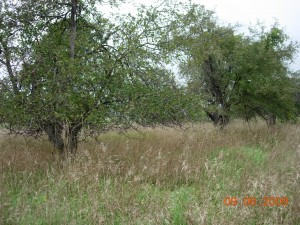
Apple trees at the Colony Farm Orchard.  Photo by Richard Brewer

Apple trees at the Colony Farm Orchard. Photo by Richard Brewer

1.  The land functions as part of the adjacent Asylum Lake Preserve.  Its wooded areas, thickets, grasslands, and wetlands enlarge the sanctuary, making the whole more diverse and more stable, in accordance with well-accepted conservation biology principles.

2. The CFO should be saved for its own sake, for its historic significance as part of the tall-grass Genesee Prairie and the Colony Farm experiment itself.  It is also of value for the wildlife species that live more safely here than at the heavily visited Asylum Lake Preserve. It is a high quality migratory stopover site for birds.  Also the vegetation and soil is steadily sequestering carbon.  Most of this stored carbon would be returned to the atmosphere as carbon dioxide if the development proceeds.

3.  There are numerous reasons why the CFO is not well suited for business park expansion:  It’s small, allowing only a few lots.  WMU will spend up to $985,000 to buy out a Michigan State University entomology lease.  The old orchard occupying one third of the site will require expensive remediation because of the lead and arsenic build-up from insecticide use from the late 1800s to 1947.

4. There are many other sites equally or better suited for the expansion.  Some are held by private owners, but WMU owns suitable lands that are nearby and have no title restrictions.

5.  The orchard was bought by the state long ago with taxpayer money.  Clearly a major motive for the proposed conversion is to convert State of Michigan assets into WMU dollars. The CFO is, in a way, an innocent by-stander.

This is the short list of arguments. You might suppose that WMU has an equivalent list of rebuttals, but that is not the case.  No one in the administration or board has been willing to engage in debate on the merits. President John Dunn has never, to my knowledge, made any public comment on the issue. Nearly all statements about the project have come from one Vice President and questions have been met, not with answers, but with marketing rhetoric about what a great success the already built part of the BTR park has been.

I hope that you and your senatorial colleagues in 2009 will be as wise as the Senate of 1993.

Sincerely yours

Colony Farm Orchard: The Western Herald Steps Up

Western Michigan University’s student paper, the Western Herald, published an article Monday 14 September 2009 on WMU’s proposed action against the  Colony Farm Orchard.  The article, by news editor Fritz Klug, was titled Arrested development for BTR? Possible expansion for WMU business research park draws controversy.

The article with two color photos occupied the whole front page.  One of the photos was a slightly elevated view of the south part of the Orchard from the west side of US–131.  The other was an aerial photo from 2007 of the Orchard and the Asylum Lake Preserve.  Both are seen to slightly better advantage in the online version, which also includes a few lines of text not present in the printed version.

The article is a worthy attempt to give the campus community the basics of what has happened and is proposed.

Two letters to the Herald responding to the article were printed on line on 17 September.  They are given below with the Herald titles .  My letter is slightly expanded here over the 300-word version submitted to the paper.

An large open-grown tulip tree now surrounded by other trees at Colony Farm Orchard.  Photo by Richard Brewer

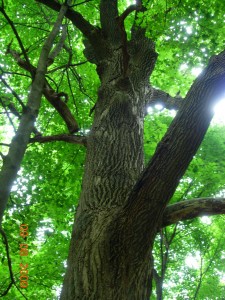
A large open-grown tulip tree now surrounded by other trees at Colony Farm Orchard. Photo by Richard Brewer

Colony Farm Orchard IS being utilized

Thanks to the Herald for information on the proposed development of the Colony Farm Orchard — currently dedicated open space.  Information has been an item in short supply around the campus.  Although many statements quoted in favor of the plan seem questionable, I’ll mention just one, by WMU Board Chairman Kenneth Miller, “That property [Colony Farm Orchard] isn’t really being utilized now.”

Exactly the same argument was made about the Asylum Lake property when WMU tried to turn it into a business park in the 1990s, and failed:  It isn’t being utilized, the public was told.

Why might the Colony Farm Orchard not be utilized, if it’s not?  One reason might be the five‑foot fence and locked gate along Drake Road.  Putting up a fence and then charging the land is not “utilized” sounds a lot like the story about the person who murdered his parents and asked the court for mercy because he was an orphan.

But in what sense is the land not utilized?  Some people have always found their way around or over the fence to bird watch, pick wild asparagus, or commune with nature.  One local documentary film maker has spent many hours there photographing wildlife.  The city of Kalamazoo dumps leaves in one area, and fishermen dig through them for worms.  Such uses go on.

But the way the land is “really” utilized is ecological.  For one thing, the biomass on the land has increased steadily since farming stopped.  This means stored carbon, so WMU — perhaps without knowing it — has been fighting carbon dioxide buildup in the earth’s atmosphere.  But most important, the Orchard makes the Asylum Lake Preserve functionally a larger sanctuary, adding habitats, species diversity, and stability.

What “not really utilized” means to WMU is that the land isn’t producing any direct income.  Income is good. But there are other goods.

–Richard Brewer

Those against orchard destruction not being heard

I am pleased to see a discussion of the Colony Farm Orchard controversy in the Herald, but ask you to treat this issue more even‑handedly. Those opposing destruction of the Orchard as open space for public use are not being heard in ways that fairly represent that position. There are at least three large issues which should be addressed in open public debate:

1.  There was an agreement made with those who transferred the property to WMU and with the community, that lands north of Parkview would remain open space for public use and those to the south would be developed by WMU without further hindrance. The public met its side of the agreement, while WMU is finding it inconvenient to honor its side. Like the U.S. Government in the land treaties it made with Native Americans, WMU is never satisfied. Instead of husbanding its resources with rational land‑use planning, it gobbles up gigantic amounts of land for very little use and quickly comes back demanding more. WMU must learn to keep its word.

2. This is not an environment versus development issue. Any growth of the BTR park could easily be accommodated by infilling at the Lee Baker farm or by redeveloping the many expansive brownfields nearby. A publicly funded research university should act in the public interest. It should redevelop abused industrial lands instead of contributing to suburban sprawl and further degradation of what little public parklands remain.

3. The process that WMU and Representative [Robert] Jones have followed seems to be designed to avoid public disclosure and discussion. Legislation was rushed through the commerce committee during August vacation time. Neighborhood groups were misled about WMU’s plans and timing. Fritz Klug’s article quotes [Bob] Miller saying, “the community will be involved with every step of the planning process.” Does this mean that once the restrictions for public use have been stripped away, WMU will start telling people what it’s going to do with what used to be their dedicated open space?

–Ladislav Hanka

Is the Colony Farm Orchard a Slam Dunk?

Hackberry at Colony Farm Orchard.  Often a floodplain tree, hackberry is also characteristic of Midwestern prairie groves.  Photo by Richard Brewer

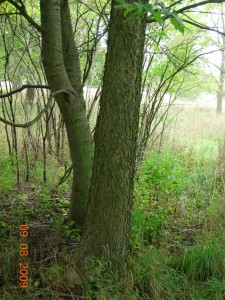
Hackberry (on the right) at Colony Farm Orchard. Often a floodplain tree, hackberry is also characteristic of Midwestern prairie groves. Photo by Richard Brewer

Western Michigan University seems bound and determined to remove the restriction on the Colony Farm Orchard.  The restriction language used by the state when it gave the land to WMU is as follows:  Western Michigan University may utilize the property solely for public park, recreation, or open space purposes, except that the legislature, by statute, may authorize Western Michigan University to utilize the property for some other public purpose.

If that restriction is deleted, WMU believes that it can then use the land to expand its business park.  The University seems totally adamant in using the Colony Farm Orchard. Nothing else will do.  Not one of various unrestricted sites that WMU also owns in Kalamazoo or Oshtemo Township.  Not a restored brownfield downtown, which would contribute to downtown revitalization and make an important environmental statement.  Not unrestricted sites in Portage.  None of these.

WMU has not offered an open forum where the issue could be explored factually rather than in terms of the marketing plan.  In fact, WMU will hardly address the issue at all.  To the best of my knowledge, the only persons connected with the WMU administration or board that have talked in public about the conversion plan are three vice-presidents.  In the past week, President John Dunn gave an interview to a Western Herald reporter and a speech before the WMU faculty and, as far as I can detect, he did not address the question in either.

What WMU’s representatives tend to do if someone raises the question, “Why do you want the Colony Farm Orchard so bad, wouldn’t some other place do just as well?” is talk about what a great job was done developing the current business park and what a great success it has been.  When pressed, the representatives have been known to bring forth three bullet points.

  • Contiguity. The dictionary says “contiguous” means sharing an edge, touching.  The short southern boundary of the Colony Farm Orchard lies across Parkview Avenue opposite a small westward projection of the current business park.  But let’s say that the two parcels are contiguous.  It may be worth remembering that the Asylum Lake Preserve is a lot more contiguous.  That is, the whole long southern boundary of the Asylum Lake Preserve lies just across Parkview from the northern boundary of the current business park.  If contiguity is a major consideration, those radicals who have been telling us that Asylum Lake Preserve itself is not safe from WMU’s hunger for more business park space could be right.
  • Advertising.  The west border of the Colony Farm Orchard abuts US–131.  Some might say it is contiguous with US-131.  The idea is that WMU needs to let the people driving by on US–131 know about the existence of its business park, or perhaps of WMU itself. Judiciously placed buildings with writing on them, or maybe billboards, will keep WMU in the public eye.  I don’t tend to think of WMU as being in retail and do not think of education in terms of curb appeal.  But this may only show how unrealistic my idea of the modern university is. I’m unwordly enough to think that a billboard extolling the Asylum Lake Preserve, including the Colony Farm Orchard, mentioning research, education, service, and conservation would be more effective advertising for WMU and its mission.
  • Bus route.  Last and least is the idea that WMU has already contracted with Indian Trails to run an express bus from campus to the business park, so it wouldn’t be hard to add a stop at Colony Farm Orchard.  All of us are supporters of mass transit, but as a reason for why the expansion must be at the Colony Farm Orchard…. Take it for what it’s worth.

In pondering the question, I’ve thought about other possible explanations for WMU’s insistence that Colony Farm Orchard is the place and nowhere else will do.  The first to occur to me is that the WMU board and its upper administration in association with various politicians, members of the Kalamazoo business community, and quasi-public booster groups are supremely confident that their plan cannot be successfully challenged.  Hence, why bother to talk about alternatives?  It’s a slam dunk.

Actually, this is the first, but also the only, explanation that has occurred to me.  It’s bolstered somewhat by various WMU actions.  One is WMU’s response to Oshtemo Township, where the Colony Farm Orchard is located. Oshtemo Township said to WMU, “This is dedicated open space in our township.  We’d like it to be retained, but if it’s to be lost, the loss should be mitigated by WMU setting aside another parcel of open space in Oshtemo.” It was an innovative proposal, the same approach used to prevent a net loss of wetlands to development.  Under Michigan law, developers usually must set aside as mitigated acreage 1.5 to 2 times the developed acreage.

WMU did not give serious attention to Oshtemo’s proposal or Oshtemo’s concerns. Why should it?  It’s a slam dunk.

The Colony Farm Orchard is clearly not the best possible site.  It’s small, allowing only a few lots.  WMU would have to spend up to $985,000 to buy out a lease held by Michigan State University to use the orchard for pest insect research.  There is a springy area that could not be developed, and much of the natural ground water flow entering the Asylum Lake Preserve comes from this section of the site.  Water management techniques employed at the current business park would probably need a great deal of modification at the Colony Farm Orchard.  Furthermore, the old orchard itself, amounting to about a third of the total site, may approximate a brownfield, and one that is not remediated.  If this old orchard is like most from its era, the ground under it is impregnated with the components of lead arsenate, the dominant insecticide on apple trees from about 1890 to 1947.

All in all, developing the Colony Farm Orchard would be an expensive proposition.

With all these considerations and others, such as the absence of any realistic need for expansion of the business park in the forseeable future, I’m puzzled.  Is there is some overwhelming advantage neither I nor anybody I know has thought of?  Is there some way WMU will derive enormous benefits by holding to their course of killing the restrictions and developing this land, this land specifically?

Perhaps someone who reads this can help.  Does one or a combination of the answers suggested above account for WMU’s implacability?  Or is there something else?

Colony Farm Orchard Items

Black-eyed susan at Colony Farm Orchard, a protected site in Oshtemo Township threatened by expansion of the WMU business park

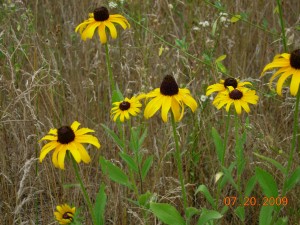
Black-eyed susan at Colony Farm Orchard, a protected site in Oshtemo Township threatened by expansion of the WMU business park

Here are a few items related to Western Michigan University’s efforts, via Representative Robert Jones, to strip the open space/public park/recreation restriction from the Colony Farm Orchard.  This property in Oshtemo Township across Drake Road from the Asylum Lake Preserve would then be sold off as lots in an expansion of the WMU Business Park.  Currently the Business Park is located on land south of Parkview Avenue across from the Asylum Lake Preserve. Here is the language of the restriction that would be dropped:

The conveyance shall provide that Western Michigan University may utilize the property solely for public park, recreation, or open space purposes, except that the legislature, by statute, may authorize Western Michigan University to utilize the property for some other public purpose.

  • A Letter to the Editor of the Western Herald from me was posted at the Herald’s website on 7 September.  There is one comment currently, but feel free to leave others there, or here.
  • Also online at the Herald is a 7 September interview with WMU President John Dunn in which he does not mention anything about the Colony Farm Orchard.
  • The Summer 2009 Michigan Environmental Report (Michigan Environmental Council) arrived today with an article on the Colony Farm Orchard.  The title is Kalamazoo conservationists fight university’s latest plan to develop natural area.  It is pretty much a shortened version of Mark Hoffman’s piece that is on my website for 28 July.
  • A short piece of film by local film-maker (Animals Among Us) Matt Clysdale taken early in August on the Colony Farm Orchard shows three Wild Turkey hens and a brood of chicks.  It is on YouTube.
  • A letter and a viewpoint speaking out against the conversion of dedicated open space to business park were published 3 September in the Kalamazoo Gazette.  The Viewpoint, by Pat Klein, was headlined Intention of Legislature in 1977 was for orchard to be set aside for public use.
  • I found no convenient link to the letter by Nina Feirer, but it was titled Write to WMU and Rep. Jones to stop land grab and here is the text: I want to add my voice to those expressing unhappiness at the idea of  Western Michigan University killing trees to make room for buildings. I am also disappointed with state Rep. Robert Jones’ part in introducing legislation to change the law so this rape of the land can take place. I have written to Rep. Jones and plan on writing to the powers-that-be at Western. Join me! We cannot let this happen.–Nina Feirer, Kalamazoo

  • Earlier letters and Viewpoints (with links)  in the Gazette on the same topic include the following:

Ladislav R. Hanka.  Deed restrictions on Colony Orchard Farm in Kalamazoo must remain intact.  Three comments by readers reacting to the online Viewpoint are also available.

Richard Brewer.  Other land is available to WMU; leave orchard alone.

Nancy Small.  Western has space, doesn’t need orchard.

Marcia V. Stucki. Use orchard for small scale agriculture.

Labor Day, West Lake Bog

Mid-morning I looked out the window and saw a small bird in the shrubs, moving about pretty actively.  It was an American Redstart, not in the black and orange adult male plumage, but rather the olive-backed, gray-headed plumage with yellow wing and tail patches that at this time of year could be a female or a young male.

We had no breeding redstarts in the vicinity this summer, so this was most likely a migrant. Perhaps Katy and I would have done to well stay home and see what else had arrived, but today was a holiday, hence worth a small excursion.

Marsh east of Westnedge Avenue at West Lake Bog .   Photo by Richard Brewer

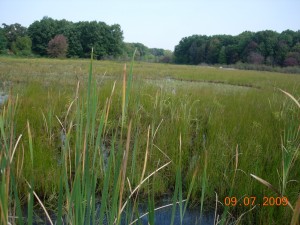
Marsh east of Westnedge Avenue at West Lake Bog . Photo by Richard Brewer

We drove to the West Lake Preserve in Portage.  It has trails, including boardwalks (of green plastic) that run out into marshes east of Westnedge Avenue. The marshes have some cat-tails but are mostly sedges plus a great variety of other herbs and a few shrubs.

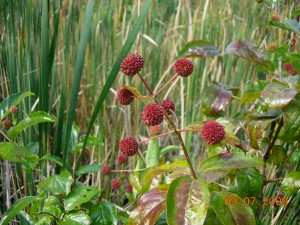
Button-bush is the most common large shrub.  It’s distinctive, easily identified with its whitish ball-like inflorescence in summer which remains ball-like in fruit but turns a rosy color.  Easily identified, as I said, as long as you find it in wet ground and it has flowers or fruits.

Button-bush fruits in marsh at West Lake.  Photo by Richard Brewer.

Button-bush in fruit in marsh at West Lake. Photo by Richard Brewer.

Once at the Michigan Nature Association’s Black River Sanctuary near Breedsville, the sanctuary steward showed me a large shrub or small tree on dry ground–though not far from the river.  It had no flowers or fruits and puzzled both of us for a while.  Having finally identified it, I think I’ll know it in the future even if it has no flowers or fruits. The fact that it has neither alternate or opposite leaves but instead often has three at a node is a quick first clue.

We were hoping for migrating warblers and other small birds, but the first birds we heard were two Sandhill Cranes.  They were coming from the south and we heard the rolling rattle they make while flying a minute or so before they came in sight over the trees behind us.  They might have been planning to land in the large patch of marsh through which the boardwalk runs if we hadn’t been there.

As it was, they flapped a little harder, regained altitude, passed over a line of trees and came down out of sight ahead of us. Not long afterward, a Great Blue Heron, another big bird though not as big as the crane, flew in from the east.  It did park in the patch of marsh we were passing through, but out of sight in a strip of water on the far side.

It turned out that we saw and heard only a few song birds.  The birds that bred here this year are mostly quiet, some still completing their fall molts.  A few Red-winged Blackbirds were still noticeable in the marshes.  The largest concentration of birds we saw was in a black gum tree.  Its leaves were already red and the ripe dark blue fruits were being visited by a good many largish songbirds.  We saw Blue Jays and catbirds, but may have missed other species.

Relatively undisturbed wetlands are always interesting botanically. There are often a lot of species, and some are in groups that present some identification difficulties. But the set of species that can handle really wet ground and especially standing water is circumscribed.  You don’t have to look through the whole plant manual to identify hydrophytes; instead you can pretty much confine your search to the specialized books on aquatics.

I don’t know what the best such manuals are today.  I still have a copy of Norman Fassett’s  A Manual of Aquatic Plants from 1957 and it serves the purpose.  A little updating of scientific names may be necessary, but that could be true if you use a manual published six months ago.

Several plants were blooming in the marshes.  In fact, flowering late in the season characterizes the wetland flora.  Among plants in flower were pickerel-weed with blue flowers, white-flowered arrowheads, and yellow-flowered bur-marigolds.

The water level was lower than we had seen in recent years, when it had come up to or over the flexible boardwalks.  Bladderworts were growing and flowering on the exposed peaty surface alongside the boardwalks.  They were tiny plants. Some species of bladderworts have purple flowers and some yellow. These plants had tiny bright yellow flowers.  I thought they might be Utricularia gibba, but I wasn’t in a serious plant-identifying mood today.

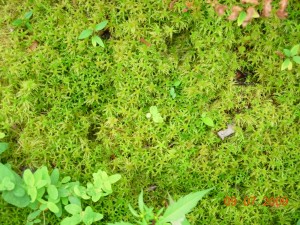
A blanket of sphagnum moss in West Lake Bog. Photo by Richard Brewer

A blanket of sphagnum moss in West Lake Bog. Photo by Richard Brewer

We continued to where the boardwalk loops back to the dirt path and followed that to the boardwalk that runs out into the sphagnum bog fringing West Lake.  The flora of bogs is even smaller and more specialized than most other wetlands, but includes many striking and beautiful species that can be seen in no other habitat.  The West Lake boardwalk is probably the best local opportunity to see this community with such things as tamarack, leatherleaf, cottongrass, pitcher plant, and sundew.

After the bog, we hiked back out to the parking lot.  It was 12:30 and we had plans to continue our holiday with lunch at the Lebanese buffet.

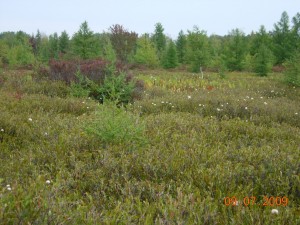
Tamarack bog with leatherleaf and cottongrass.  Photo by Richard Brewer

Tamarack bog with leatherleaf and cottongrass. Photo by Richard Brewer

Colony Farm Orchard Conversion: Good Business, Smart Politics, or Betrayal of a Public Trust?

The maneuver being pushed by Western Michigan University to convert the Colony Farm Orchard from protected open space to business park was on the agenda for the Oshtemo Township Board last Tuesday night, 24 August 2009.  Representative Robert Jones who introduced the bill to be taken up the following day in the House Commerce Committee (chaired by Representative Jones) was there. So was a WMU representative, Senior Vice President for Advancement and Legislative Affairs Gregory Rosine.

Oshtemo is interested in the matter because it is their open space that is in danger of being lost; the Colony Farm Orchard lies west of Drake Road, thus in Oshtemo Township, which happens not to be in Representative Jones’s district.

As it worked out, the Orchard was the first agenda item right after the pledge of allegiance and approval of the minutes.  Jones spoke in generalities and expressed his solidarity with the trustees in the hard job of local government.  Rosine talked about what a boon WMU’s current business park had been, citing numbers and mentioning compliments received.

Unfortunately, not all of Senior Vice President Rosine’s statements were entirely factual.  He sought to allay the Trustees’ misgivings about the restriction that Jones’s bill would lift, a restriction that reads as follows:

The conveyance shall provide that Western Michigan University may utilize the property solely for public park, recreation, or open space purposes, except that the legislature, by statute, may authorize Western Michigan University to utilize the property for some other public purpose.

Senior Vice President Rosine explained to the Trustees and citizens of Oshtemo that in those days (1977) it was routine when the state conveyed land to a university that there be a restriction that the land be kept as open space.  But, he explained, such an idea was no longer valid.  Rather, we are more enlightened now and it is understood that the highest and best use of land is for such things as business parks that will generate jobs and make money.

Senior Vice President Rosine seemed not to know that this restriction was, in fact, not in the original language of the conveyance (House Bill 4058). It was added by Robert Welborn, Representative from Kalamazoo.  At this time his brother John was the State Senator from the Kalamazoo area.  Interested in increasing protected open space in the Kalamazoo area, the two Republican legislators had also been involved in the 1975 transfer of the Asylum Lake parcel to WMU with the identical restriction.

Rosine also mentioned the $1.5 million endowment established at the Kalamazoo Community Foundation in 1998-1999, but somehow left the impression that it was connected with the business park.  In fact, it was raised for the stewardship of the Asylum Lake Preserve, including its defense against future attempts to violate the conservation restrictions placed upon it.

The bill sponsored by Representative Jones is short.  If you leave out the legal descriptions of the parcels, it amounts to no more than four pages.  It is, nevertheless, a remarkable, almost magical, device.  It does two things:  The state adminstrative board will pay WMU a dollar for the Colony Farm Orchard.  The state administrative board will then sell it back to WMU for a dollar but with a new restriction as follows:

The property shall be used exclusively for the purpose of expanding and improving the business technology and research park located on western Michigan university’s Parkview campus.

You see why I call the bill magical.  It is like a stage magician’s cabinet.  The old conveyance with a conservation restriction goes in like the magician’s beautiful assistant. The door is closed and locked. Seconds later, when it’s reopened, the new conveyance comes out looking entirely different, rather like a goat, with a restriction that requires WMU to do exactly what it has always wanted to do with the orchard.

Oddly enough, the original conveyance with the restriction to open space, public park, or recreation use was not provided in the bill.  The Commerce Committee members, with the exception of Representative Jones, had no way of knowing prior to the meeting that it existed.

Tuesday night, the Oshtemo Township board seemed in their questions and discussion to be leaning toward the position that they would prefer that the Orchard be left as protected open space but that if it were converted, Oshtemo’s loss should be mitigated by the provision of other protected open space in some multiple of the acreage of the Orchard.  Jones and Rosine pointed out that time was too short for a discussion of such matters.  The bill would be taken up by the Commerce Committee the next day, and in response to a question, Representative Jones assured the Township Board that it would be approved.  Vice President Rosine promised Township Supervisor Libby Heiny-Cogswell that his office would be in touch with her to set up a meeting to talk about the mitigation matter.

In response to a question as to whether the bill could be fast-tracked in such a way that it might be passed by both House and Senate in a week (as had happened with an earlier bill which had targeted Oshtemo Township), Jones had said, no, the House was meeting the next day and then not again until the following Tuesday, 2 September.  He did not rule out the possibility that it would be taken up then (and approved, since the House has a Democratic majority).

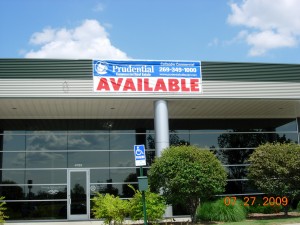
View in Western Michigan University Business Park 27 July 2009.  Photo by Richard Brewer

View in Western Michigan University Business Park 27 July 2009. Photo by Richard Brewer

As a citizen of Oshtemo Township, I made a few remarks trying to correct some of the misleading statements.  I also pointed out that if the time ever came when more space was actually needed in the WMU business park, many other choices are available, including several parcels that WMU already owns in Kalamazoo and Oshtemo Township.

Although WMU has sometimes given the impression that expansion room is urgently needed, three spaces in the business park are still unclaimed, at least two spaces have become vacant and available for lease, and a large area devoted to soccer fields occupies part of the business park and could be developed.  Besides, times are hard and several of the conditions that contributed to the relatively strong showing of the business park in the past may no longer apply.  It is by no means clear that any expansion room will be needed in the foreseeable future.

A brief account of the Oshtemo Board meeting was published in the Kalamazoo Gazette the next day.  Representative Jones was as good as his word, and the bill was unanimously adopted in the Commerce Committee on Wednesday and sent to the full house.  The Gazette reported that action also.

Today is Tuesday September 2.