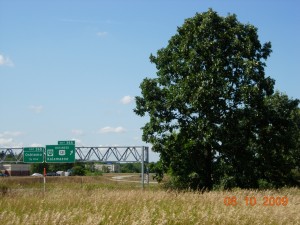
A bur oak at the west edge of the Colony Farm Orchard with US-131 in the background
From statements by Western Michigan University’s PR guy, we know what WMU thinks the Colony Farm Orchard is good for–expansion of the University’s business park.
The motivation for such an action is unclear, as are the need for it and what the expansion would involve. But none of these needs to concern us here. We want to talk about how the property ought to be used, in keeping with the restrictions on the land contained in the original transfer to WMU in 1977. Public Act 316 (Sec. 1.2) said
The conveyance shall provide that Western Michigan University may utilize the property solely for public park, recreation, or open space purposes, except that the legislature, by statute, may authorize Western Michigan University to utilize the property for some other public purpose.

The Colony Farm Orchard is at the upper left in this diagrammatic map which appears on the WMU website
To situate ourselves, the 54-acre property lies across Drake Road from the main body of the Asylum Lake Preserve. The right-of-way for the expressway US-131 is the west boundary, Parkview Avenue is the south boundary, and Stadium Drive is the north boundary. Actually, nine acres just south of Stadium Drive is owned by the Western Michigan University Foundation (the old trailer park land) but evidently would be included in the Business Park expansion, bringing the total to about 63 acres.
WMU has done very little with the land. It allowed Consumers Energy and other utilities to use land for the very visible transmission installations in the southwest corner. These service the current business park, but whether it was wise or prudent to use part of the protected Colony Farm Orchard for them is debatable.
Also, a large leaf composting operation for part of the city of Kalamazoo is located a little north of the utility transmission facilities. A large-scale composting operation is better environmentally than landfilling yard waste, but whether this use meets the public park/recreation/open space criterion is doubtful. The utility installation and composting operation each have separate service roads coming in from Drake Road.
We should also mention that Michigan State University holds a lease that provides that its Department of Entomology has use of the orchard for as long as it “conducts experimental fruit pest research on the land.” (In preparation for selling the property as part of its business park operations, WMU has indicated that it will pay MSU up to $985,000 to cancel the lease.)
WMU’s main action in recent times has been to erect a fence along the Drake Road boundary making entrance difficult for anyone not willing or able to climb over it. Access from the south next to the big Consumers Energy facility is possible–and perfectly legitimate since the justification for WMU having the land is, as we know, for public park, recreation, or open space. But many people, seeing the fence and the locked gate at the composting entrance, would conclude that WMU wanted to prevent access to the property.
The role I’d like to see this property play is exactly what it’s doing now, but better.
What it’s doing now is, for one thing, buffering the main body of the preserve from the noise and noxious fumes of the expressway. That’s good, but it’s not the land’s most important function. The land functions ecologically as an integral part of Asylum Lake Preserve.
The Declaration of Conservation Restrictions adopted by the WMU Board in 2004 says that its first goal is to promote ecosystem integrity by, among other things, maintaining the Preserve as green space and wildlife habitat and protecting natural features from further degradation. The existence of the Colony Farm Orchard next to the other property contributes to this goal.
The Asylum Lake property itself is not large. At one time it was 274 acres, but that was before land was carved out for widening Parkview and Drake, for sidewalks on two sides, and for parking spaces. Biodiversity, the number of species, is strongly dependent on the size of a preserve. The Colony Farm Orchard site only a few tens of feet from the Asylum Lake property effectively adds 63 acres, bringing the total size of the protected area to something on the order of 320 acres.
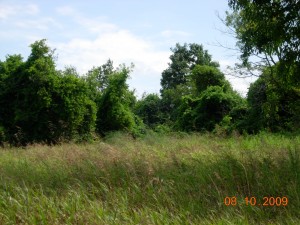
Grape vines covering trees in abandoned orchard
How does adding these 63 acres add diversity? One way is by adding new habitats. The old orchard itself, a dense thicket type of vegetation, is different from any vegetation on the east side of the preserve. Also the area of springs lying partly on the Orchard property and partly on the south portion of the Foundation property is a different and rather unusual habitat.
Biodiversity on a preserve is lowered by local extinctions of species and raised by immigration of individuals of new species. Simply the additional acreage is important in preventing extinctions–or reversing them. Suppose that all three breeding pairs of the black-capped chickadee, a year-round resident on the Asylum Lake Preserve, die one winter from some combination of causes and their offspring also disappear by dispersing elsewhere or by death from predation, starvation, etc. One species has been lost from the preserve.
Now suppose that on the combination of Preserve plus Orchard we start with six pairs. The chance that all six and all their young will be lost in the same winter is perhaps half the likelihood that three will disappear. Next year, the survivors may be able to breed and thrive and replenish the chickadee population. This replenishment, or rescue effect, is an important way in which species diversity is maintained on larger preserves or ones located in close proximity to one another.
This is the role in biodiversity that the Colony Farm Orchard plays–not just for birds, but mammals and insects, turtles and frogs, and other organisms. It’s possible that the WMU business park may also function in this same way interacting with the restored grassland on the southwest side of the Asylum Lake Preserve for grassland birds–though probably not for birds of other habitats.
Another effect that the Colony Farm Orchard enhances is the role that the Asylum Lake Preserve has as a migratory stopover site. Retaining habitat where migratory birds can rest and refuel on their migratory flights south and north is a new focus in conservation. Recent studies have looked at what traits make good stopover sites. For fall migration, fleshy fruits–eaten in late summer and fall even by insectivorous birds–are favorable. The old orchard has these in abundance in the form of grapes, blackberries, and others.
For spring bird migration, insects, especially such forms as midges hatching from ponds and streams are important food sources. The springs and spring-fed pond at the north end of the property would provide this steadily renewed food for the northward migrants.

Young acorns on bur oak at Colony Farm Orchard August 2009
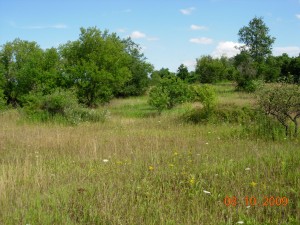
The Orchard property has other habitat features that add to its value as a part of the Asylum Lake Preserve. I’ll mention only one more here. The western part of the property was within the historic Genesee Prairie. The rest of it was bur oak plain, a closely related community. This tells us that the spring area lying at the north end of the Orchard and the south end of the ten acres owned by the WMU Foundation was almost certainly prairie fen. In years of low water in the past, I have identified fen plant species in the wetlands at the west edge of Asylum Lake directly opposite. Prairie fen is a remarkably attractive and diverse ecosystem that The Nature Conservancy and the Michigan Natural Features Inventory have given high priority for protection in Michigan.
It would make good conservation sense to restore tall-grass prairie in a wide band along the western fence of the Orchard property and to restore prairie fen on the springy wetlands at the north. Southwest Michigan genotypes of plants should be used.
I’ll try to make other specific suggestions as to how the land might be used in a later post.
 When I arrived at Western Michigan University in 1959, Michigan was in the midst of an ornithological Golden Age. Dozens of ornithologists were practicing their science in the state or had recent (or soon-to-come) connections. Nearly every college and university had one to several faculty members with a special interest in birds.